Szia!
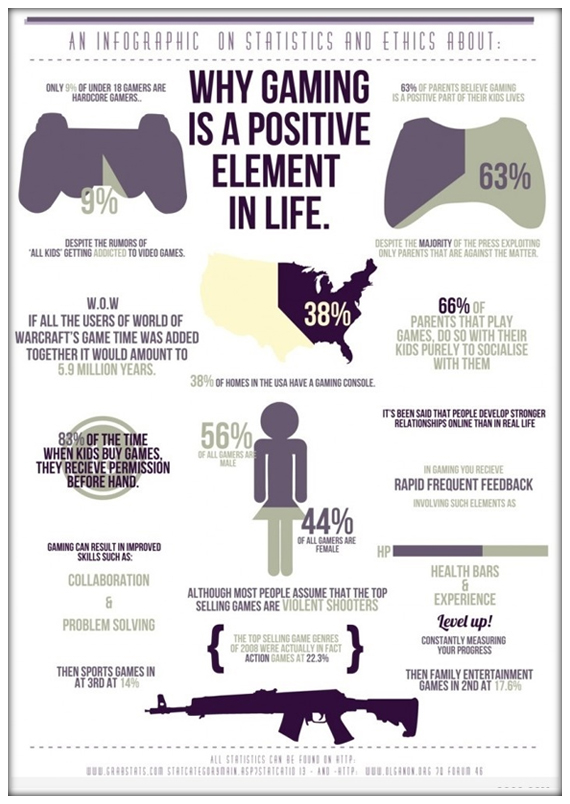
Good infographic
I like so much this infographic that shows the positive facts of gaming.
All information from http://www.grabstats.com/
Labels:
digital games,
gaming_concepts,
infographic,
market
Kinds of players
What kind of player are you? It's a complicated question and in fact there are a lot of kinds of players. Just to give an example we can talk about the proposed types of players in a Massive Multiplayer Online Game. Schreiber (2009) citing Bartle (1996) says that in this genre of game it's possible to identify four types of players:
•Achievers >> find it enjoyable to gain power, level up, and generally to “win” the game (to the extent that an ongoing, never-ending game can be “won”).
•Explorers >> want to explore the world, build mental maps of the different areas in their heads, and generally figure out what is in their surroundings.
•Socializers >> use the game as a social medium. They play for the interaction with other players. The gameplay systems are just a convenient excuse to get together and play with friends.
•Killers >> (today we call them “griefers”) derive their fun from ruining other people’s fun.
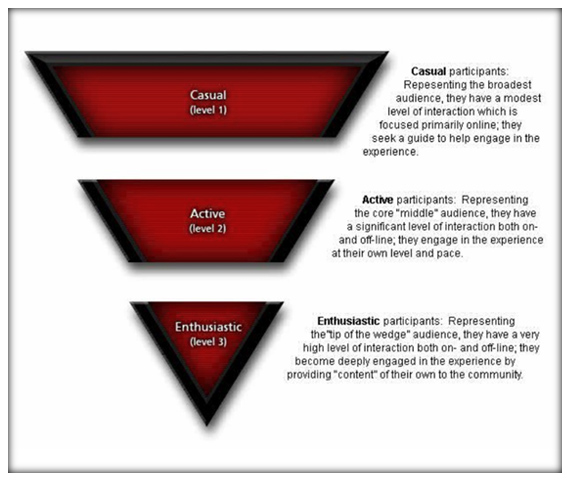
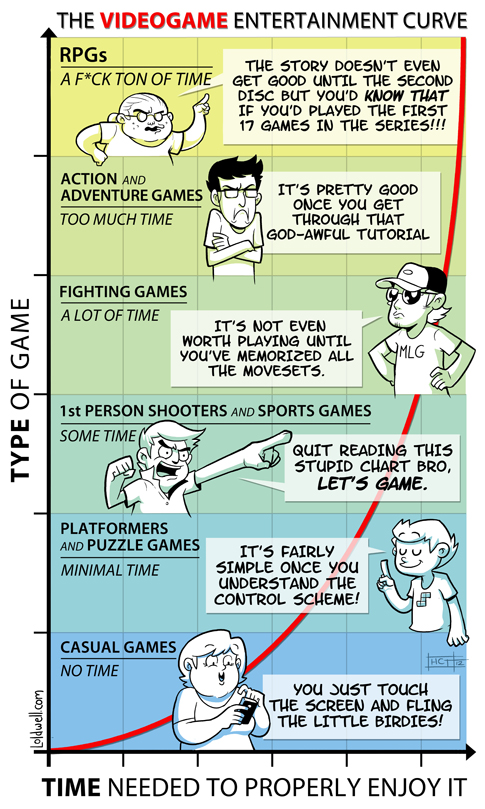
I think it's impossible to categorize all kinds of players of all gaming genres but I really like the synthetic idea of the graph below:
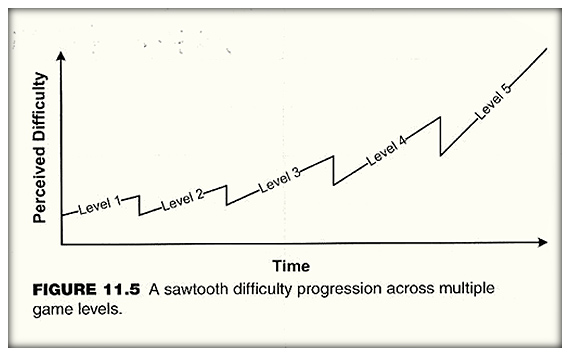
The most important point in the discussion about kinds of players is: know your audience to know how to create a consistent difficult progression and a good experience to the players. The next graph (from Fundamentals of Game Design, p.345) summarizes this thought:
I believe this is another fundamental concept to apply in game design.
What do you think about that?
References:
ADAMS, Ernest. Fundamentals of Game Design. New Riders: 2009
BARTLE, Richard. HEARTS, CLUBS, DIAMONDS, SPADES: PLAYERS WHO SUIT MUDS. Digital article (link here)
SCHREIBER, Ian. Kinds of Fun, Kinds of Players. Digital article (link here)
•Achievers >> find it enjoyable to gain power, level up, and generally to “win” the game (to the extent that an ongoing, never-ending game can be “won”).
•Explorers >> want to explore the world, build mental maps of the different areas in their heads, and generally figure out what is in their surroundings.
•Socializers >> use the game as a social medium. They play for the interaction with other players. The gameplay systems are just a convenient excuse to get together and play with friends.
•Killers >> (today we call them “griefers”) derive their fun from ruining other people’s fun.
I think it's impossible to categorize all kinds of players of all gaming genres but I really like the synthetic idea of the graph below:
What do you think about that?
References:
ADAMS, Ernest. Fundamentals of Game Design. New Riders: 2009
BARTLE, Richard. HEARTS, CLUBS, DIAMONDS, SPADES: PLAYERS WHO SUIT MUDS. Digital article (link here)
SCHREIBER, Ian. Kinds of Fun, Kinds of Players. Digital article (link here)
Labels:
game,
game_design,
gaming_concepts,
players,
vincevader
The concept of cybertext
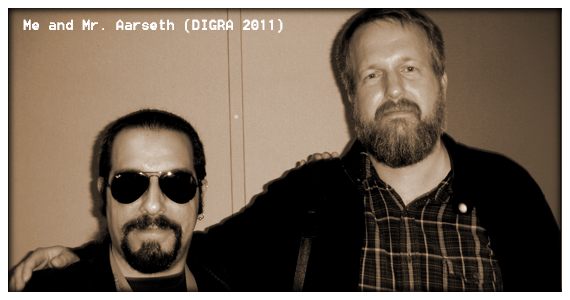
Last year (at DIGRA 2011/Netherlands) I had the honor to know personally one of my favorite authors: Espen Aarseth. Aarseth is a main figure in the fields of video game studies and electronic literature.
I really like some ideas from his book Cibertext and I want to share them in this post. I think that cybertext is an important concept inside the game design universe.
As Aarseth says:
The concept of cybertext focuses on the mechanical organization of the text, by positing the intricacies of the medium as an integral part of the literary exchange. However, it also centers attention on the consumer, or user, of the text, as a more integrated figure than even reader-response theorists would claim. The performance of their reader takes place all in his head, while the user of cybertext also performs in an extranoematic sense. During the cybertextual process, the user will have effectuated a semiotic sequence, and this selective movement is a work of physical construction that the various concepts of “reading” do not account for. This phenomenon I call ergodic, using a term appropriated from physics that derives from the Greek words ergon and hodos, meaning “work” and “path”. In ergodic literature, nontrivial effort is required to allow the reader to traverse the text. If ergodic literature is to make sense as a concept, there must also be nonergodic literature, where the effort to traverse the text is trivial, with no extranoematic responsibilities placed on the reader except (for example) eye movement and the periodic or arbitrary turning of pages. (page 1)
I believe this is a fundamental concept to apply in game writing.
I really like some ideas from his book Cibertext and I want to share them in this post. I think that cybertext is an important concept inside the game design universe.
The concept of cybertext focuses on the mechanical organization of the text, by positing the intricacies of the medium as an integral part of the literary exchange. However, it also centers attention on the consumer, or user, of the text, as a more integrated figure than even reader-response theorists would claim. The performance of their reader takes place all in his head, while the user of cybertext also performs in an extranoematic sense. During the cybertextual process, the user will have effectuated a semiotic sequence, and this selective movement is a work of physical construction that the various concepts of “reading” do not account for. This phenomenon I call ergodic, using a term appropriated from physics that derives from the Greek words ergon and hodos, meaning “work” and “path”. In ergodic literature, nontrivial effort is required to allow the reader to traverse the text. If ergodic literature is to make sense as a concept, there must also be nonergodic literature, where the effort to traverse the text is trivial, with no extranoematic responsibilities placed on the reader except (for example) eye movement and the periodic or arbitrary turning of pages. (page 1)
I believe this is a fundamental concept to apply in game writing.
What do you think about that?
Reference:
AARSETH, Espen. Cibertext: Perspectives on Ergodic Literature. The Johns Hopkins University Press: Maryland, 1997.
Reference:
AARSETH, Espen. Cibertext: Perspectives on Ergodic Literature. The Johns Hopkins University Press: Maryland, 1997.
Labels:
aarseth,
cyberculture,
digital games,
gamingconcepts,
text
Experience – part II
By Vince Vader
I think there are three great aspects that help us understand the involvement of the players with the game universe: the idea of a labyrinth, the concept of virtual presence and the concept of flow.
I like to use the idea of a labyrinth of games as a metaphor. I think it's important to offer the player a chance to get lost inside the game world. But it's very important to offer this as a challenge to be completed and not as a bad sensation that leads the player to nowhere. As Kerényi wrote, the concept of a labyrinth is possibly a cultural good of all humanity whose origins date back to the Stone Age (page 66) and possibly all the ludic activities results in a kind of maze (page 72). So we can conclude that the idea of a labyrinth is - in some way - a mythological heritage of us all.
Nitsche (page 203) in reference to Slater (1993) talks about forms of presence and argues that “presence” is understood as the mental state where a user subjectively feels present within a video game space as the result of an immersion into the content of the fictional world. It is a mental phenomenon based on a perceptual illusion. In reference to Lombard and Diltron (1997) Nitsche (page 203) says that a great number of researchers have concentrated on the idea that a state of presence should be connected to the illusion of a nonmediated experience. In this case, players do not see the interface anymore because they feel present in the world beyond the screen.
The last concept I want to discuss is “flow”. I’ll go back again to the author Michael Nitsche to complete this thought. Nitsche (page 204) citing Csikszentmihalyi (1991) says that “flow” has been introduced as a state in which a person is fully immersed in an action and highly focused to the extent that one can experience, for example,
a loss in the feeling of self-consciousness and time experience. A player who reaches this level is clearly immersed in the game but not necessarily “present” in the virtual space.
All these features help us to create good experiences involving games.
In a future post I want to discuss some ways to generate the idea of a labyrinth and the concepts of presence and flow. Szia!
References:
CSIKSENTMIHALYI, Mihaly. Flow: the psychology of optimal experience. New York: Perennial (HarperCollins), 1991.
KERÉNYI, Karl. En El laberinto. Madrid: Ediciones Siruela, 2006.
LOMBARD, Matthew & DITTON Theresa. At the heart of it all: the concept of telepresence. Journal of Computer-Mediated Communication 3, no. 2 (1997): 1-39.
NITSCHE, Michael. VIDEO GAME SPACES - image, play and structure in 3Dnworlds. Massachusetts: MIT Press, 2008
Labels:
digital games,
gamingconcepts,
ideas,
ludic,
ludology,
theory
Experience
By Vince Vader
I want to discuss in this post the importance of creating relevant experiences for players inside the video games. The idea of writing about this subject came from a brief discussion I had with a game designer friend.
Nowadays we have more complex tools to create amazing experiences in video game platforms like 3d graphics, complex soundtrack and interaction with motion devices (like Kinect). But if we think about famous video games from the past, it is possible to notice that game designers created amazing experiences with few resources, too.
Technology changed a lot of things in this area, but the essence of creating a good gaming experience is still the same: players want to have fun.
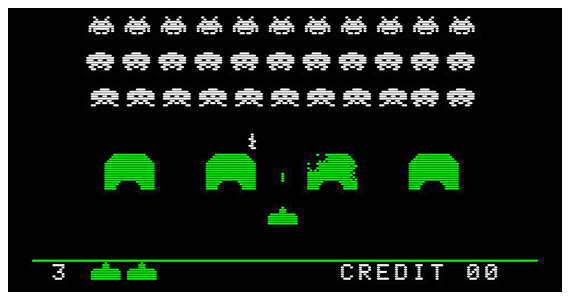
I always like to use classic games as examples, and I want to use Space Invaders (Tomohiro Nishikado, Taito, 1978) as a good case study in this subject. Space Invaders had limited resources in its creation but it’s a great game still today.
Space Invaders has all the things a game needs to give the player a great experience:
1) Simple and elegant interface. You just need to move left/right, shoot aliens in the sky and try to protect your ship in the limited energy fields;
2) The game has tension. As the invaders come closer, they get faster;
3) The game has no soundtrack, but it has a constant and scary sound (like a heartbeat) that gets faster as the invaders come closer.
As we can see, limited resources did not prevent the creation of a great > game.
As Nitsche wrote: “the narrative perspective emerges from the available interactive options, but also from the way the space is told to the player. The mediated plane works like a narrative filter between the rule-based plane and the play space” (2008, page 145).
So? What do you think about that?
References:
NITSCHE, Michael. VIDEO GAME SPACES - image, play and structure in 3Dnworlds. Massachusetts: MIT Press, 2008
Wikipedia: http://en.wikipedia.org/wiki/Space_Invaders
I want to discuss in this post the importance of creating relevant experiences for players inside the video games. The idea of writing about this subject came from a brief discussion I had with a game designer friend.
Nowadays we have more complex tools to create amazing experiences in video game platforms like 3d graphics, complex soundtrack and interaction with motion devices (like Kinect). But if we think about famous video games from the past, it is possible to notice that game designers created amazing experiences with few resources, too.
Technology changed a lot of things in this area, but the essence of creating a good gaming experience is still the same: players want to have fun.
I always like to use classic games as examples, and I want to use Space Invaders (Tomohiro Nishikado, Taito, 1978) as a good case study in this subject. Space Invaders had limited resources in its creation but it’s a great game still today.
1) Simple and elegant interface. You just need to move left/right, shoot aliens in the sky and try to protect your ship in the limited energy fields;
2) The game has tension. As the invaders come closer, they get faster;
3) The game has no soundtrack, but it has a constant and scary sound (like a heartbeat) that gets faster as the invaders come closer.
As we can see, limited resources did not prevent the creation of a great > game.
As Nitsche wrote: “the narrative perspective emerges from the available interactive options, but also from the way the space is told to the player. The mediated plane works like a narrative filter between the rule-based plane and the play space” (2008, page 145).
So? What do you think about that?
References:
NITSCHE, Michael. VIDEO GAME SPACES - image, play and structure in 3Dnworlds. Massachusetts: MIT Press, 2008
Wikipedia: http://en.wikipedia.org/wiki/Space_Invaders
Labels:
digital games,
game design,
gamingconcepts
Jane McGonigal: Gaming can make a better world
Games like World of Warcraft give players the means to save worlds, and incentive to learn the habits of heroes. What if we could harness this gamer power to solve real-world problems? Jane McGonigal says we can, and explains how.
Labels:
games,
gamingconcepts,
jane,
McGonigal,
TED
Subscribe to:
Posts (Atom)