Showing posts with label vincevader. Show all posts

Talking about my new mobile game DOMINAEDRO

Last week my new game, DOMINAEDRO, landed at the App Store. The game is a strategic puzzle that mixes dominoes and tic-tac-toe. It’s is an abstract battle between two players that uses pieces of domino as weapons.

The game, originally, was analogic and was launched as an independent title in the beginning of this year. After lots of positive reviews from Brazilian (and even European) sites I decided to transform the analogic version into a digital game.

The game is very simple and I will share the main idea of the rules below. The game’s grid is arranged with nine numbers randomly selected by the system. In a decreasing order: the highest number will be allocated in the center, intermediate values will be around the highest one, and lower values will be on the corners.


Your starting hand has 3 domino pieces. The player with the lowest sum of numbers in a single piece starts the game. On your turn, you must try to put a single piece in the grid respecting the following rules:

1) A number in a domino can only touch a piece with the same number, or lower, in the grid.
2) Like in a domino game, pieces connected on the grid must have the same numbers.
3) Every time you choose a piece, the system will point out the spaces allowed for allocating on the table.


You earn points by dominating a sum on the grid. For that, you should be the player with the highest sum of numbers around a value. In case of a tie, the sum of the second values of dominoes sets the winner. In case of a tie in both sides of the dominoes, the winner will be the player with more pieces.

The game ends when you cannot allocate more pieces on the grid. Each piece not allocated is worth -1 point. Values of the grid that were not completely surrounded by pieces are scored normally.

If a player has dominated all values in a row, column or diagonal, they win 4 extra points for each line. The player with the most points wins the game. Check a short video demo with the game mechanics below:


You can download DOMINAEDRO for free. Click here for more information. I’m waiting for your suggestions, critics and improvements.

Go gamers!

Recreating game mechanics

One important thing about game design is the ability to learn from games. The act of creating a repertory full of different references and mechanics is fundamental for the work of a game designer.

With great knowledge of these points it is possible to recreate game mechanics. To demonstrate this, I will use as an example in this post a game that I created: ÁLMOK.


ÁLMOK is a card game for 2 to 4 players that uses an oneiric world as a scenario. Players need to find combinations of dreams to escape from a nightmare dimension.

The game mechanics were based in the classic memory game, with some modifications. In the original memory game, the idea is to find a pair of equal images, but in ÁLMOK, the players need to find three of a kind. After a player finds a “combo” of three cards, he or she earns a special coloured gem. Each gem has a special power (like discard cards from the table, see hidden cards, etc.) that could be used in the turn of a player.

So, in essence, it’s a memory game, but we have some “turbo” modifications.

The game is played with a 64 deck of cards in a 8x8 grid that offers a major challenge for the player’s mind.

Ceilikan Games launched the game in Brazil in February 2013. The art made by me and ÁLMOK means “dreams” in Hungarian language.

At this moment, I’m working on a translation into English for the rules and a print and play version to make available for download to non-Portuguese speakers. Wait for news!

F.R.O.G (Future and Reality of Gaming) Congress - Vienna, September 2013

Last week I was at Vienna (Austria) presenting a poster at the F.R.O.G (Future and Reality of Gaming) congress. Awesome keynotes and fantastic content in three days full of games in this beautiful city.


Vienna’s annual Games Conference offers an open and international platform for leading game studies researchers and scholars, game designers, researchers and scholars from various other fields, education professionals, and gamers from around the world. The main objective of FROG13 was to explore the “Context Matters” in regard to questions of player communities, challenging or problematic play settings, game theory and development, impact of games and cultural facets of play.

And now I would like to share the content that I presented at the congress. I hope you enjoy.


ECOLOGICAL CONCEPTS IN A BOARD GAME: How to discuss serious causes using ludic interfaces

Author: MsC. Vicente Martin Mastrocola (ESPM/Brazil)
E-mail: vincevader@gmail.com


MINI-ABSTRACT

In this presentation we seek to analyze the use of game mechanics for serious causes. We discuss, using a brazilian board game named Climate Game, how we can use a playful and ludic interface to cast a message for a serious cause and how a game could work with ideas about global warming in a fun/educational way. In this context, we use the idea of magic circle proposed by Johan Huizinga, author of the book Homo Ludens, in which the author explains how a physical space could be a place for playing, meaning and experience.

In this presentation we also discuss the impact of a ludic interface in the mediatic scenario, the gaming culture and how important it can be for the contemporary world.


SLIDES


TEXT

Homo Ludens, entertainment and games

First of all, the notion of homo ludens, introduced by the dutch historian Johan Huizinga, is the conceptual backbone for this work, where we seek to analyze the use of game mechanics, ludic concepts, and game thinking applied to a brazilian board game with ecological theme named Climate Game. This game uses a playful and ludic interface to cast a message for a serious cause, and works with ideas about global warming in a fun/educational way.

In his book "Homo Ludens" (1955) Huizinga discusses the possibility that playing is the primary formative element in human culture. The author also presents the idea of the magic circle, one important subject for our discussion.

As described by Adams and Rollings (2009, p.8), Huizinga did not use the term as a generic name for the concept: his text refers to the actual playground, or a physical space for playing, meaning and experience. As the authors says, inside the magic circle, real-world events have special meanings. In the real world you kick a ball into a net but in the magic circle you score a goal.

Huizinga (1955, page 10) wrote that the arena, the card-table, the stage, the screen, etc, are all function playgrounds. They are all temporary worlds within the ordinary world, dedicated to the performance of an act apart.

As Ehrmann says (1968, p.55) in an antropology of play, the latest cannot be defined by isolating it on the basis of its relationship to an a priori reality and culture. To define play is, at the same time and in the same movement, to define reality and culture.

The Climate Game

The Climate Game is a production from a brazilian company named Games For Business that works in the area of serious games, that, following the thoughts of Nick Iuppa and Terry Borst (2007), may be explained as games with a professional, educational or pedagogical use. Climate Game is a game that challenges its players to save the world from global warming. This game is both of competition and cooperation. It promotes competition because the player who emits no carbonic gas at all wins. But the integrated work of all the other participants is essential in order not to exceed the gas limits of the greenhouse effect.

Therefore, participants have lots of puzzles to solve together and, as Juul says (2005, p.8) games are usually well-structured problems, and this has led them to be used in several other fields.

This kind of game will not transform a player into a specialist in ecology or in global warming, but it can reinforce important concepts about the planet’s health. This game can teach basic ideas and stimulate the players to search for more information about the theme.

By this brief overview we can conclude that game mechanics can be a meaningful space for significative experiences. It seems that these ideas are essential to study and understand the gaming universe and the impacts of the game culture in the contemporary world.

Poster


REFERENCES

ADAMS, Ernest; ROLLINGS, Andrew. Fundamentals of Game Design. New Jersey: Pearson Prentice Hall, 2009

EHRMANN, Jacques. Homo Ludens Revisited. Yale French Studies, No 41. Game, Play, Literature (1968). pp. 31-57. (click here for download)

HUIZINGA, Johan. Homo Ludens: A Study of the Play-Element in Culture. Boston: The Beacon Press, 1955.

IUPPA, Nick & BORST, Terry. Story and simulations for serious games: tales from the trenches. Burlington: Focal Press, 2007.

JUUL, Jesper. Half-Real: Video Games between Real Rules and Fictional Worlds. USA: MIT Press, 2005.

Climate Game english site >> click here.

Retrospective

In 2012 I had the chance to be in many conferences, meetings and see excelent presentations about game design and gaming concepts.

I discussed many ideas with great professionals in São Paulo, Rio de Janeiro and Porto Alegre (Brazil); Cannes (France); Santiago (Chile), Antwerp (Belgium) and Copenhagen (Denmark). It's possible to say that 2012 was a good year full of ludic discussions.


It was a year full of discussions and new doubts. So, in 2013, I propose an attitude to dwell on: "discuss more about games", instead of only "play games".

As I said in an old post "the games of tomorrow need answers that last". I think that a broader research about games will bring us better answers about how we can use games beyond fun and understand how they can change the world.

My point is that this is the century of playfulness, and more than just thinking of a way to offer games to a diverse audience, we should learn how to offer various languages of entertainment – where the game is also inserted.

Finally, I wish you a 2013 full of games and ludic interfaces. GO GAMERS!

Now on to your opinion!

Brazilian Ludic Interfaces: an internacional presentation

Right now I'm in Belgium giving a presentation at the University of Antwerp about BRAZILIAN LUDIC INTERFACES. Next week I will be in Denmark presenting the same content at the University of Copenhagen.

You can see the highlights of the presentation on the PDF below:


Or you can download the document with the complete contents through THIS LINK.

This is a unique opportunity to make new acquaintances and improve my research about the ludic field and ludic interfaces. Cross yours fingers for me!

Go gamers!

Ecological concepts in a game

By Vince (@vincevader)

Today I’ll talk a little bit about Climate Game a game that I developed for a brazilian company named Games For Business (check out the english site here >> http://www.games4b.com). Games For Business works in the area of serious games, that, following the thoughts of Nick Iuppa and Terry Borst, may be explained as a game with a professional, educational or pedagogical use. It's a kind of game that mixes storytelling with mechanics that mean to send a serious message to the players involved in the process.

Climate Game is a game that, when played with strategy, negotiation and diplomacy, challenges its players to save the world from imminent destruction. With everyone’s effort and awareness, the emission of carbonic gas can be reduced before it is too late.


This game is both of competition and cooperation. It promotes competition because the player who emits no carbonic gas at all is the winner. But the integrated work of all the other participants is essential in order not to exceed the gas limits of the greenhouse effect that the planet can put up with. If this limit is exceeded, the Earth’s temperature will have risen to a level where human life is not possible and everyone dies/loses.

Therefore, participants must have a good degree of knowledge regarding gas emission and the greenhouse effect and also be very good at negotiating and formulating strategies.

This kind of game won’t make you a specialist in ecology or in global warming, but can reinforce important concepts about the health of the planet. The game can teach basic ideas and stimulate the players to search for more information about the theme. I think this is the core of a good serious game.

And if you want to play good serious games with a lot of contemporary concepts, check this URL: http://www.molleindustria.org/ .

SZIA!


Reference:

Iuppa, Nick & BORST, Terry. Story and simulations for serious games: tales from the trenches. Burlington: Focal Press, 2007

Cannes Creativity Festival 2012

The world's most important festival of creative advertising will happen this month in Cannes.

There is a new category for the festival: mobile games. And a game that I've created for .MOBI agency is competing in this cattegory!

Check the video case below.


And cross yours fingers for me! I'll be there.

Szia

Game design process: a third approach

By Vince

In this present post I want to discuss the details about the creation of my new board game, PYRAMYZ.

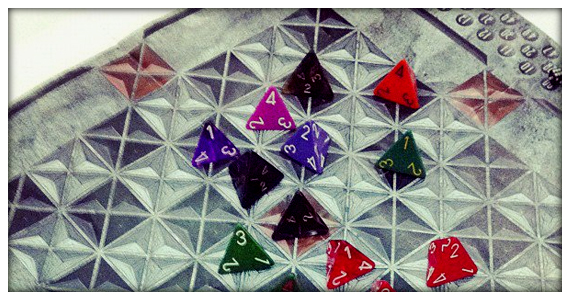
PYRAMYZ is an independent title that will be hopefully launched next month. It is an abstract game for two players that uses pyramidal dice (D4) as pieces and has an area control game mechanics.

The inspiration for part of the game mechanics came from “Chinese checkers”, a very traditional abstract game where the pieces jump other pieces (or a row of pieces) to reach the player’s side on the board.


In PYRAMYZ, first of all, players must choose the color “black” or color “white”. This part is important because each player earns points by having the dice on top of their color spaces. It is possible to get points joining dice with the same color adjacent (orthogonally), when this happens the players achieve the number of points of the dice upon the respective color spaces.

The objective is to achieve the higher number of points.

In this game a player can put the dice from a bag on the board or move a die that has been placed on the board. A roll is required to put a die in the game , because the random number on the D4 will be the number of spaces the piece can move (orthogonally) by the board. A die will spawn from five special areas with different color.

For this game I created four prototypes with different dynamics, layouts and rules. It’s important to have many views in a game design process to choose the bestconnection between them. I started with a triangular board but it was not good, the traditional orthogonal grid proved to be the best option.

In this part of the creative process I defend the use of simple prototypes. It’s essential to use simple drawings, ordinary material and have total focus on the game mechanics.


After a lot of tests and a minimum certainty about the functionality of the game I recommend to generate a better prototype/layout. And remember: beta testing is not about playing your game alone by hundred times, it is about putting one hundred people to play once and have a lot of different feedbacks.

In two previous posts I’ve talked about the process to create another board game and a SMS mobile game (links here and here). I recommend the reading of both posts to complete the idea of this one.

Wait for news about the PYRAMYZ’s launching!

Story of my (game designer) life

A long time ago in the city of São Paulo (Brazil), around 14 years in the past, there was a great Comic & RPG encounter happening. I was in the event with a bunch of good nerd friends.

At the time we had the opportunity to attend a presentation of the author Michael Mulvihill, best known for publishing awesome RPG books like "Shadowrun" and "Battletech", which, by the way, were part of my adolescence.

I watched the presentation of Mr. Mulvihill, which proved extremely inspiring for all those who were there, and wanted to give life to their own games.

When the lecture ended, I asked for an autograph and asked him a question: "Mr. Mulvihill, what is required to be a good game designer? ". And he answered me:


Years later, I've found this paper inside an old drawer and realized how much truth there was in those words. I think the idea is to play games, experience games and interact with ludic interfaces all the time. The message of Mr. Mulvihill is about getting good references and repertoire because this is essential to create good gaming projects.

So we can apply these concepts in several areas of knowledge and create good experiences.

So, play games and have fun.

Ludificator

In this moment I'm writing a book named "LUDIFICATOR". It's a quick reference guide for the newbie game designers. I hope someday this content will be translated to english.

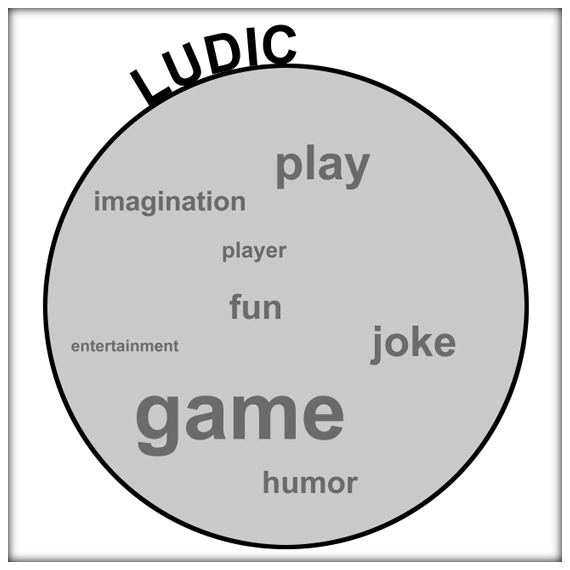
In the third chapter of my book I bring an idea I've discussed in the first post of this blog (link here): the idea of Ludification.

And now I have a good graph to illustrate this concept, as you can see below:

I'm trying to explain that the idea of Lufication is better than Gamification because in my point of view, the Game is inside the Ludic Field.

In my book I tried to demonstrate that it is more adequate to call activities with game mechanics as Ludic Interfaces.

Hang on! The book is coming out soon!

Transmedia Storytelling & Games

I want to delimitate in this short post the concept of transmedia storytelling (JENKINS, 2006): a kind of narrative which develops into multiple mediatic platforms, such as internet, books, video games, comics, television and movies. I want to highlight one specific use of this strategy in the entertainment industry.

I'm going to show to You the strategic appropriation of transmediatic narratives in the industry of entertainment using an established example: the Star Wars fiction series transformed into a Lego board game.

In the movie below it's possible to see how the idea of the movie "The Empire Strikes Back" becomes a board game.


Every game is an unique experience. Every game have a different end. The essence is the same of the movie but players have the opportunity to change the famous battle of Hoth with dice results.

What do you think about that?


Reference:

JENKINS, Henry. Convergence culture: where old and new media collide. NYU Press, 2006.

Interview with Espen Aarseth

We have something new in this post: the first interview of the blog. An interview with Espen Aarseth (one of my favorite authors).

Espen J. Aarseth is a figure in the fields of video game studies and electronic literature. Aarseth was born in Bergen, Norway, in 1965 and completed his doctorate at the Department of Comparative Literature at the University of Bergen. He co-founded the Department of Humanistic Informatics at the University of Bergen, and worked there until 2003, at which time he was a full professor. He is currently Principal Researcher at the Center for Computer Games Research at the IT University of Copenhagen.

Let's rock!

Vince: There's a lot of definitions for "game". From Huizinga to contemporary authors we can find a lot of ideas about this subject. What's your definition of "game"?
Espen: I am with Wittgenstein on this one; '"game" ("Spiel") is a concept that cannot be formally defined, and when we try to do so, we inevitably end up with merely a definition of a sub genre. I do have a definition of games, but I also acknowledge that this is an overproductive definition, that also includes phenomena such as musical instruments: "Games are facilitators that structure behavior, mainly for the purpose of entertainment." Note that I don't use the word 'rules', but the broader term 'structure'.

Vince: What you think about the buzzword "Gamification"? Do you think it's a good concept to define the use of game elements in non-game activities?
Espen: It is an ideological attempt to make games important and useful; and a very naive view of how humans can be controlled. A scenario where gamification is successful could only be a nightmare. But in 7-8 years it will be forgotten. So do check my prediction in 2020.

Vince: In your book named "Cybertext" You said that "the concept of cybertext focuses on the mechanical organization of the text, by positing the intricacies of the medium as an integral part of the literary exchange". In what kind of game it's possible to see it clearly?
Espen: Mechanics is a crucial aspect in almost all games. Games are obvious, almost trivial examples of what I was talking about there. As I made clear in Cybertext, games are combinations of two layers, the semiotic and the mechanical, and this sets them apart from non-cybernetic media such as novels and films.

Vince: Send a message to the new researchers of the gaming concepts and game design field.
Espen: I believe we are entering a new phase in game research, where we already see glimpses of an academic field with professional standards of quality. We are not quite there yet, but hopefully the early days of sloppy research, terrible quality control and half-baked theorizing will soon be over. Things can only get better!

Vince: Thank you!
Espen: You are welcome!

Goals and rewards

By Vince

At this moment I'm working on my new board game named PYRAMYZ, a dice game that uses D4s as paws in an orthogonal board. I hope to cast this game by April or May of this year. I intend to write a complete review of the creative process of this new game after the launching, very similar to the review of my other board game named YN (link here).

While the production of the game is not finished I want to discuss an important point of the game design process: the creation of a logical goal/reward to the game mechanics. In the moment of conception of a new game, it is very common to think about components, complex mechanics, layout, and sometimes we forget to create a good and clear goal/reward to offer the players.

The goal of my new game is simple: to be the player with most victory points. And how can You get victory points? Putting the higher values of D4 dices in the squares of your color in the board. It's possible to have an idea in the image below:

In the book “Game Design: principles, practice, and tecniques - the ultimate guide for the aspiring game designer” there is a good view about this subject. The authors say:

“A crucial aspect of a game is that has a definite goal, and reaching this usually allows an individual to win. Goals can include eliminating the other player(s) from the game, achieving an identified target (for example by amassing a number of points), winning a race, or collecting a certain type of token.

Achieving the goal - winning - can be its own reward. A player may have defeated his opponent through his superior game-playing skill or he may simply have been lucky with random factors.

Many modern games, digital and non-digital, do not rely on winning as the sole reward but are designed so that all of the players can derive some enjoyment from the process of playing the game
”. (page 13)

Another good gaming concept! What do you think about that?


Reference:

THOMPSON, Jim; BERBANK-GREEN, Barnaby; CUSWORTH, Nic. Game Design: principles, practice, and tecniques - the ultimate guide for the aspiring game designer. New Jersey: Wiley, 2007

Kinds of players

What kind of player are you? It's a complicated question and in fact there are a lot of kinds of players. Just to give an example we can talk about the proposed types of players in a Massive Multiplayer Online Game. Schreiber (2009) citing Bartle (1996) says that in this genre of game it's possible to identify four types of players:

•Achievers >> find it enjoyable to gain power, level up, and generally to “win” the game (to the extent that an ongoing, never-ending game can be “won”).

•Explorers >> want to explore the world, build mental maps of the different areas in their heads, and generally figure out what is in their surroundings.

•Socializers >> use the game as a social medium. They play for the interaction with other players. The gameplay systems are just a convenient excuse to get together and play with friends.

•Killers >> (today we call them “griefers”) derive their fun from ruining other people’s fun.

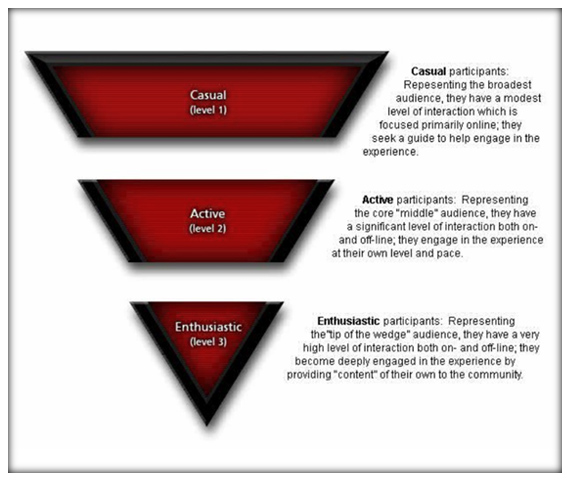
I think it's impossible to categorize all kinds of players of all gaming genres but I really like the synthetic idea of the graph below:

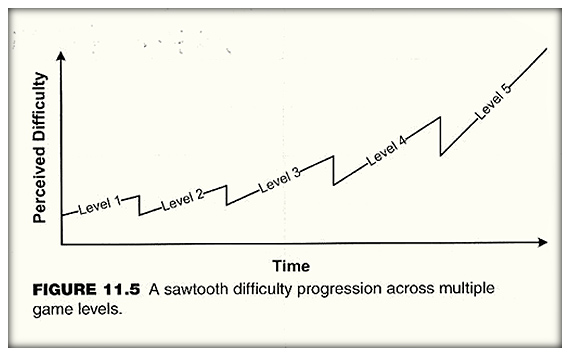
The most important point in the discussion about kinds of players is: know your audience to know how to create a consistent difficult progression and a good experience to the players. The next graph (from Fundamentals of Game Design, p.345) summarizes this thought:

I believe this is another fundamental concept to apply in game design.

What do you think about that?


References:

ADAMS, Ernest. Fundamentals of Game Design. New Riders: 2009

BARTLE, Richard. HEARTS, CLUBS, DIAMONDS, SPADES: PLAYERS WHO SUIT MUDS. Digital article (link here)

SCHREIBER, Ian. Kinds of Fun, Kinds of Players. Digital article (link here)

Merry Christmas

And a new year full of games!

Game design process: a second approach

By Vince

In a previous post I’ve talked about the process to create a board game. In this post I intent to discuss a different kind of game design process, I want to discuss the creation of a mobile phone game made in SMS (short message service).

The game discussed in this case is a promotional game made to a Brazilian mobile company named VIVO and the name of the game is “VIVO EM AÇÃO” (something like “live in action” in English). This promotional action was a detective game with a history focused on clues and enigmas; the player takes an investigator role and needs to solve a lot of mysteries to have more chances to gain the promotional prizes (PlayStations, mobile phones, backpacks, etc.).

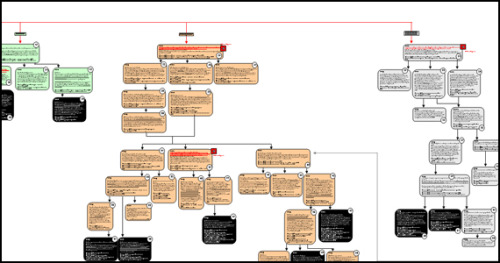
The game is based in mobile text messages. So we needed to create a script with information architecture basis; the script of the game is made of what we can call “decision trees”.

This is very simple to understand: it’s very similar to an old role playing game book. You read a paragraph and the text shows you a bunch of options to go ahead in the narrative.

For instance:

“Detective, you are in front of the university. What are you going to do? Option 1: enter the building; Option 2: search for clues around; 3) Option 3: try to enter the back door”

So each chapter of the game (and we made five chapters) looks like this:

As a promotional game, it is important to create points in the narrative where we can offer pay services from the mobile company. So, we decided to put – as a help to the players – hints and tips of the game that the player can buy using services and other tools of the company.

The great challenge here is to create a game based only in limited text (because each message needed to have a maximum of 138 characters) and build an immersive and fun narrative to get the player inside the story.

This promotion had a great audience. Around 2 million of people participating in it, making it a successful Brazilian case.

It was a great challenge to create this game because of his limitations. But I think that limitations are an important piece of the game design process.

And you? What do think about that?

Game design process: an approach

By Vince

I would like to discuss game design in this post. More specifically, the design of a boardgame. It’s a game I’ve created and it’ll be published next month here in Brazil.

The game I'll use as an example in this post is YN (this is greek for "earth"). However, the game suffered a lot of changes from its creation until it was published. I want to show the different phases of this game design process.

Also, I would like to emphasize that this is just one way we can use to create games. I believe each game designer has his/her own techniques to create game ideas and gaming concepts.

•STAGE 1: write ideas, rough draft and pre-prototype them

First of all, I believe it is important to have a notebook to write your ideas. In this moment, use the force and let your mind flow, start to write every important thing. I use to call this process “single player brainstorm”.

While writing the ideas try to draw some rough drafts of the core idea of the game. It’s the first tests of mechanics and dynamics.

In the case of YN, I was thinking of an area control game with dices and dominos sequence mechanics. I’ve made a lot of studies and drawings to reach the balance of core mechanics, board layout, number of dices to each player and the most important: seeing if the game works

I think it's important – in this moment - to consider the idea that game design is the process of creating the content and rules of a game, and good game design is the process of creating goals that a player feels motivated to reach and rules that a player must follow as he makes meaningful decisions in pursuit of those goals. (BRATHWAITE & SCHREIBER, 2009)

So, in a few days I had a lot of rules notations and a pre-prototype board to start a beta test with some friends. In the picture below it’s possible to see the first model of the game (without an official name at this moment) made with paper, pen and a bunch of white dices.


•STAGE 2: prototype with simple layout

Well, if the pre-prototype works I think it’s fine to make a better version of the product. It’s time to make a real prototype in the computer using a minimum of layout just to give the game a clear aspect.

I always use Photoshop to create my prototypes. There’s a lot of tools in the software and it’s possible to make fast layouts in its interface.

In this part of the process I had an idea for the name of the game. I called it “Hatszög” (it means hexagon in Hungarian, I know it´s weird, but I am a hungarian language student) and I made a better board, bought good dices and even made a box with a simple illustration. And an important thing: in this moment the game had its rule book ready.

In the next picture it’s possible to see the prototype with a simple layout.


•STAGE 3: final and published version

So, we reach the third and final part of our game design process. A Brazilian company named HIDRA GAMES asked for an idea for a collection of abstracts games. This company already had a first game named AERO (with the idea of AIR element as the main theme) and was searching for a mechanics for the second game of the series: YN (with the EARTH theme).

So “Hatszög” turned into YN and a lot of things changed. In the mechanics we added a new element: a stone token that creates different setups on the board; so now it’s possible to put a sequence of dices from your pool and sometimes block the opponent’s strategy (and we made a lot of new beta testing sessions to adjust this new feature in the game). Just to remember and explain, the goal of the game is to place the biggest amount of dices as possible in the board, with the purpose to finish the game with the smaller sum of numbers on the remaining dices.

Well, the name has changed and the game gained a brilliant art from Marcelo Bissoli (a specialist in boardgame layout). He made a lot of changes like removing hexagons and putting circles in place. Marcelo also made a very beautiful volcanic background to the board and a spectacular box with a very vibrant and strong logo. Now we a have a finished game in all phases.

And the text behind YN’s box tells us: “Billions of years ago, when the earth was just an incandescent globe that began to cool - big masses of rocks and ores, that were before in a liquid state, started to solidify, creating what we call today a terrestrial crust. The magma, still boiling and liquid, started big waves around an unstable soil and this huge rock layers collided and rose from the soil, creating the mountains. In YN a player will experience the idea of creating these mountain rages using dices in a scenario that simulates the Earth at its formation process”.

Let´s see a little bit of the final layout of the game:


In a few words I think I transmitted the core idea of a game design process. I intend to show, in another post, the game design process to a narrative game, more specifically a mobile phone game where the player uses only SMS (short message service) to play. There are a lot of differences to show.

Viszontlátásra! =)

•REFERENCE:
BRATHWAITE, Brenda & SCHREIBER, Ian. CHALLENGES FOR GAME DESIGNERS: non-digital exercises for vídeo game designers. USA: Cengage, 2009.

My DIGRA 2011 publication: Using a game as an advertising piece for a brazilian politics campaign

I´ll share my DIGRA 2011 publication in this blog. I presented this case in 15th september (2011) in the Think Design Play Conference at Utrecht School of Arts and Technology (Hilversum). Enjoy!

•ABSTRACT
We seek to analyze the use of a game as an advertising piece for a brazilian politics
campaign. We discuss the impact of a game in the mediatic scene of internet and how
important it can be for a new political scene in the contemporary world. Keywords: Serious game, internet, politcs, casual game

•INTRODUCTION
In this presentation we seek to analyze the use of a game as an advertising piece for a politics campaign. We are talking about the game “Pacto pelo Pará” (Pact for Pará –
Pará is a brazilian state), that was used on the elective campaign of governor Simão
Jatene in the year of 2010.

•DESCRIPTION AND SOME THOUGHTS
The game consists in a very intuitive interface, based on the well-known internet game
named Bejeweled. It has four stages and instead of gems, social problems (education,
sportes, healthcare) are presented, to be solved. The player needs to click in similar
ortogonal icons to eliminate them of the screen. A lateral score shows how much of the
objectives were accomplished. In the picture below, it´s possible to see the game interface.

Figure 1: the interface of the game. There´s a time counter, a score for points and a bonus multiplier. The icons in the center of the screen reflects social problems to be solved. (design and code by Cenildon Muradi Jr.)

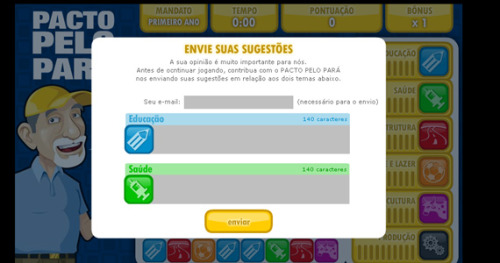
The player, at the end of each stage, has the opportunity of sending their collaboration on a 140-character text form. The opinions expressed by each player at the end of each stage are put in a weblog and belong to an idea of a collaborative government. Obviously there’s a filter to ban the posting of offensive content. At the end of the fourth stage, the player has the opportunity of taking a picture using their webcam along with the point record achieved in the game, and challenging a friend to make a higher score. In the picture below, it´s possible to see this feature of the game.

Figure 2: in the end of a stage it's possible to send opinions, critics and praise about the social problems to the political group.

For a better understanding of the game there´s an internet adress for it in
http://www.vincevader.net/conference/

This game fits on the Casual Game category, that, according to Gregory Trefay, can be
defined as games that are quick to play, accessibles and with a simple mechanics. In this kind of game: the rules and goals must be clear; players need to be able to quickly reach proficiency; casual game play adapts to a player´s life and schedule; game concepts borrow familiar content and themes from life.

It also enters the category of Serious Game, that following the thoughts of Nick Iuppa and Terry Borst, is explained as a game with a professional, educational or pedagogical use. a kind of game that mixes storttelling with a mechanics to send a serious message to the players envolved in the process.

We recently observed that the campaign for the U. S. President Barack Obama, amongst many other tools, used games and advertising inside games (in-game advertising) in it. We notice the importance of using a gamelike language to reach the digital-native audience. On the game Pacto pelo Pará, we notice the importance of using the game as an instrument of gathering, with an interface for social network and thus, becoming a viral marketing tool for the candidate’s campaign.

In this context, we use the idea of Johan Huizinga, author of the book Homo Ludens, in which he explains that in the human nature there is a tendency to play games or other ludic activities.

With this work, we sought to collaborate with the entertainment industry and the gamedeveloping area, specifically politic games.

•PDF PRESENTATION
View more presentations from vincevader


•REFERENCES

HUIZINGA, Johan. Homo Ludens. São Paulo: Perspectiva, 2005.

Iuppa, Nick & BORST, Terry. Story and simulations for serious games: tales from the
trenches
. Burlington: Focal Press, 2007

TREFY, Gregory; KAUFMANN, Morgan. Casual Game Design. Burlington: Morgan Kaufmann, 2010

PopCap Games. (2000). Bejeweled. [Intrenet, first version], PopCap Games, USA: played january, 2011.

What is Game Design?

I´ll talk a little bit about game design in this post. I think it's an important discussion to bring to the blog.

Game design is a process of: imagining a game; defining how it works; describing the elements that are going to be part of the game (concept, art, foundation); passing these data on to the team that will produce it.

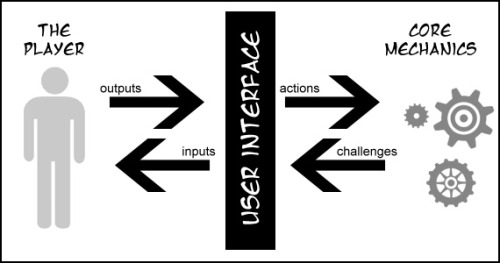
And we can't forget to talk about game key-components . Game key-components are: core mechanics (the kernel of the game); the challenges and actions ; interface (how the player interacts with the game ); and storytelling engine (the immersive screenplay itself).

The graph below show us this idea:

We can use this ideas in any platform: board games, video games, war games, etc. It´s important to have a good sinergy between the player, the interface and the core mechanics.

If you like this concepts i'll suggest a very good book named Fundamentals of Game Design (ADAMS, Ernest. Fundamentals of Game Design. New Riders: 2009).

Enjoy!

Twitter

Competition