Showing posts with label market. Show all posts

Article: Brazilian Gaming Market

Craving to disseminate information about the Brazilian gaming market, my friend Mauro Berimbau and I wrote a brief article explaining some peculiarities of this environment with many relevant research data. We want to share our feelings with you.


Click here to download the PDF. We are waiting for your opinions!

Essential data about the global gaming market

A world of possibilities in new platforms with many players.


Source: Digital Spy (2013)

Money through mobile games

As you know, I’m a postgraduate research student and graduation level teacher in Brazil. At this moment, I’m teaching Digital Media and Gaming Concepts to my students. In a specific class about mobile gaming there’s question that comes up every semester: “How can we make money through mobile games?”

Ok, the world is going mobile and everybody wants to create the new Angry Birds to become a millionaire, but it’s essential to analyse some important business models inside this complex (and gigantic) market. In this post I just want to highlight some of these models. It is not my intention to write a complete document about this subject.


1. Freemium (a neologism mixing “free” and “premium”): is a business model by which a game is provided free of charge, but money is charged for advanced features, functionalities, or virtual goods. “Cut the rope” is an example of freemium game because you can download the content and play ten stages of the game, but if you want the complete experience its mandatory to pay. “Zombie Tsunami” is an example of how a company can make money with in-game equipment (players are invited to visit a virtual shop to buy scenarios, powers, clothes, etc. with real credits).

2. Ads and banners: there are a lot of free games with advertising inside its interface. It’s very common to find a free game with ads/banners in the screen. Sometimes it sucks but someone needs to pay the price and advertising could be an answer.

3. In-Game Advertising: refers to the use of digital games as a medium for the delivery of advertisements. This is a better way to put products and services in the interface. We have a lot of examples of brands that created games for its products, like “CP3K” running game from Nike.

4. Free for long-term profit: a good strategy for small companies in the beginning of its existence is to give the whole game for free or put the game for free for a while and put a minimum price on it after a few weeks. In the beginning it’s necessary to build a name in the mobile gaming field. If your first game was good, certainly people will pay for expansions or new ones.

5. Put a price on it: there’s no rule about a price for a mobile game. In this case it’s important to have an overview about similar games to create a coherent value to your game.

There’s a lot of another strategies to create “talkability” and make your game to go viral. It’s possible to distribute promotional numbers for free downloads to influent people, use social media, etc. but this is a subject for another post.

Now on to your opinion.

Brazilian gaming market

Good content to share: high level game facts from the brazilian national gamers survey.
Source: NEWZOO (2011)

Nintendo Wii U: First Impressions

Last week I tried the new Nintendo console Wii U at the Brasil Games Show fair (by the way, the biggest videogames fair in Latin America). After a long waiting, my friend Mauro Berimbau and I played a few games on the new platform. I'm going to share some opinions in this post.


In forty minutes we tried three games: New Super Mario Bros U, Nintendo Land (with the shuriken mini game) and Zombie U.

However, I don't want to make an analysis on the games. I want to highlight my very first impressions about the Wii U:

1. The tablet joystick is a little bit strange and big in a first moment. I really like the idea of a "second screen", but it's not very comfortable.

2. The graphics are average. New Super Mario Bros U is beautiful, but Zombie U could be better.

3. Everything made for Wii also works on Wii U (games, joysticks, accessories). That's a positive point.

4. It's clear to me: the Wii U focuses on families and casual players.

5. The tablet has a camera (there are games with camera interaction), the internet connection operates well, and the idea of the console is to be a kind of media hub. However, in my humble opinion, Nintendo is far from Xbox Live in the field of social networking.

6. The tablet joystick has potential with the second screen mode. But even PS Vita and Surface (Microsoft's tablet) have already been doing it.

I really want to buy the new console to play at home. I think I'll have new points of view about the product. Until there, let's enjoy a video about Wii U below.


Go gamers!

New data about the brazilian gaming market

Brazil doesn’t have a formal gaming industry, and the country holds high levels of piracy. However, a recent survey made by a brazilian research institute shows that:

1 - There are 46 million gamers in Brazil (23% of the population);
2 - The most frequently used platforms: 67% console, 42% computer, 17% smartphone or tablet and 7% portable consoles.
3 - 47% of the gamer audience are women.
4 - The current market is US$ 500 million, but in 2016 the brazilian market is expected to reach US$ 2 billion.


There is no doubt that we have a potential market.

Then there is the question: why doesn't the market grow anymore?

The answer is: the lack of government incentives is delaying the development of the brazilian gaming industry. High taxes hinder progress. Bureaucracy keeps foreign companies away from our territory.

Isolated initiatives do not gain strength. What remains is to wait for better times.

A brief presentation of gaming market in Brazil

I received a mail from an american user asking me to put some information about gaming market in Brazil. So, I'll share some brief ideas about this subject.


First of all, Brazil doesn’t have a formal industry of games. In Brazil we have high levels of piracy, high taxes for foreigners products, and a Playstation 3 game could cost around U$ 90.

However, Brazil is a wide country (190 million people) and is the country with greatest navigation time in the internet of the world (22 hours a week). Brazil is the country has 200 millions of active mobile devices (30% smartphones and 70% mobile phones) so, internet and mobile are good platforms to develop games and entertainment.

I'll try to find some researches about our market (in english) to publish here.

Szia!

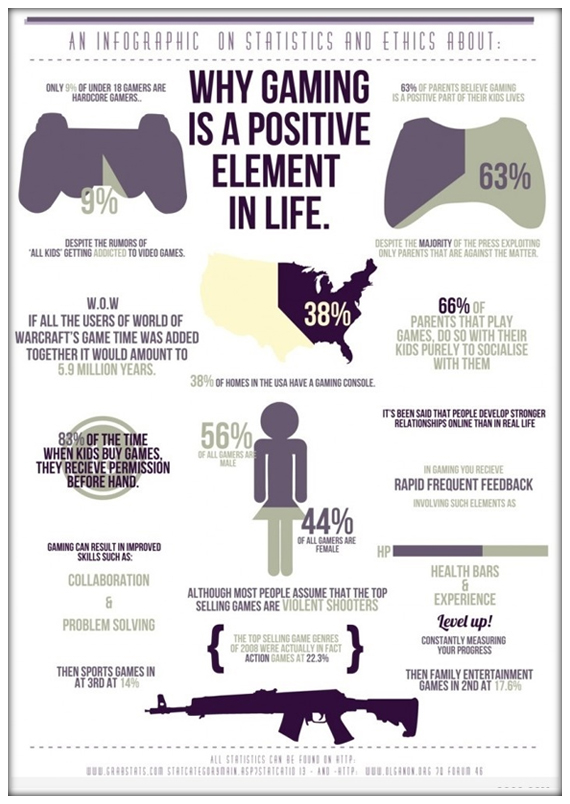
Good infographic

I like so much this infographic that shows the positive facts of gaming.

All information from http://www.grabstats.com/

Szia!

# Why study games?

In this post I intend to show seven points of view to answer this question. There are some interesting links to download .PDF documents in the end of topics. Enjoy!

1.First of all, in the last eight years the game industry has grown more than any other in entertainment and games have overdone cinema revenues and are now the third industry in the world, being beat only by weapons and automobilistic industries.

2.Globally, the online gamer community – including console, PC, and mobile phone gamimg – counts more than 4 million gamers in the Middle East, 10 million in Rússia, 105 million in Índia, 10 million in Vietnam, 10 million in México, 13 million in Central and South América, 15 million in Austrália, 17 million in Soth Korea, 100 million in Europe, and 200 million in China.
Source: Games Segmentation 2008 Market Research Report (download link)

3.With all of this play, we have turned digital games (PC, consoles, mobile phones, etc.) into what is expected to be a $68 billion industry annually by the year 2012.
Source: NewZoo Amsterdam 2010 (download link)

4.In the USA:
• 97% of youth play computer and video games;
• 69% of all heads of household play computer and video games;
• 40% of all gamers are women;
• One out of four gamers is over the age of fifty;
• The average game player is thirty-five years old and has been playing for 12 years;
• Most gamers expect to continue playing games for the rest of their lives.
Source: ESA Essential Facts 2010 (download link)

5.Collectivelly, the planet is now spending more than 3 billion hours a week gaming.
Source: McGONIGAL, Jane. The reality is broken. London: The Penguin Press, 2011, pg. 5

6.In 2010 the first person shooter game"Call of Duty: Black Ops” has sold over U$ 1 billion in the first month.

7.The truth is this: in today´s society, computer and video games are fulfilling genuine human needs that the real world is currently unable to satisfy. Games are providing rewards that reality is not. They are teaching and inspiring and enganging us in ways that reality is not. They are bringing us together in ways that reality is not.
Source: McGONIGAL, Jane. The reality is broken. London: The Penguin Press, 2011, pg. 4

Twitter

Competition