:.
:.

In this present post I want to discuss the details about the creation of my new board game, PYRAMYZ.
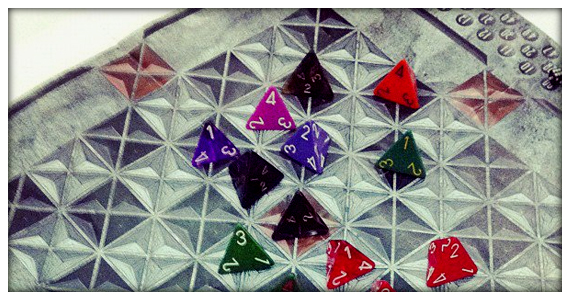
PYRAMYZ is an independent title that will be hopefully launched next month. It is an abstract game for two players that uses pyramidal dice (D4) as pieces and has an area control game mechanics.
The inspiration for part of the game mechanics came from “Chinese checkers”, a very traditional abstract game where the pieces jump other pieces (or a row of pieces) to reach the player’s side on the board.

(Art by Marcelo Bissoli)
In PYRAMYZ, first of all, players must choose the color “black” or color “white”. This part is important because each player earns points by having the dice on top of their color spaces. It is possible to get points joining dice with the same color adjacent (orthogonally), when this happens the players achieve the number of points of the dice upon the respective color spaces.
The objective is to achieve the higher number of points.
In this game a player can put the dice from a bag on the board or move a die that has been placed on the board. A roll is required to put a die in the game , because the random number on the D4 will be the number of spaces the piece can move (orthogonally) by the board. A die will spawn from five special areas with different color.
For this game I created four prototypes with different dynamics, layouts and rules. It’s important to have many views in a game design process to choose the bestconnection between them. I started with a triangular board but it was not good, the traditional orthogonal grid proved to be the best option.
In this part of the creative process I defend the use of simple prototypes. It’s essential to use simple drawings, ordinary material and have total focus on the game mechanics.

After a lot of tests and a minimum certainty about the functionality of the game I recommend to generate a better prototype/layout. And remember: beta testing is not about playing your game alone by hundred times, it is about putting one hundred people to play once and have a lot of different feedbacks.
In two previous posts I’ve talked about the process to create another board game and a SMS mobile game (links here and here). I recommend the reading of both posts to complete the idea of this one.
Wait for news about the PYRAMYZ’s launching!