Showing posts with label mobile. Show all posts

Interview with Jesper Juul

This week we have a special post on Gaming Conceptz. Jesper Juul, the video game theorist, gave this blog a special interview. I had the honor of meeting the author last year at the F.R.O.G (Future and Reality of Gaming) Conference. Enjoy the content! Thank you so much Mr. Juul. May the force be with you. =)


Bio: Jesper Juul is a video game theorist and associate professor at the Royal Danish Academy of Fine Arts - The School of Design, and a visiting associate professor at Comparative Media Studies/Writing at MIT. He has been working with video game theory since the early 1990s, at the IT University of Copenhagen, MIT, and at New York University. His previous books are the video game theory classic Half-Real and A Casual Revolution. He recently published The Art of Failure, a book that combines personal confessions about failure with philosophy, game design analysis, psychology and fiction theory.


1) In your last book 'The Art of Failure' you talk about 'the pain of playing video games' in a very interesting way. What was your primary inspiration source to write about this subject?
Two things: 1) That our interaction with video games is clearly filled with frustration and unhappiness, yet we tend to talk about video games in purely positive terms - good, great, awesome, deep etc.. Why are we not talking about this darker side of game playing, and why do we play games even though it is there? 2) My personal experience as a very sore loser of all types of games. Losing makes me very frustrated, yet why is losing so important to me?

2) 'The Art of Failure' is about video games. Can we use the same ideas for board games and card games?
I used mostly video games as examples, but most of the discussion applies to all games. Video games then add some particular twists, especially in terms of single-player games, where the designer can closely follow the progress of the player and tweak the difficult and failure rates to match the player's current skill level.

3) In your keynote at F.R.O.G. 2013, you talked a little bit about "Gamification". This buzzword became very popular recently. What do you think about this buzzword? Do you think it's a good concept to define the use of game elements in non-game activities? Do you think it's correct to use 'game thinking' instead?
Like most buzzwords, gamification is overused, overhyped etc.. We could try to introduce a different term, but I think we should rather try to live with "gamification" and then explain what its problems are, what the advantages are etc.. I.e. the important thing is not the word itself, but what we use the ideas for, and how we implement them.

Gamification is a good idea in some activities.

It works best for situations where users / students / employees are in need of feedback, and when the gamification system allows the user to exercise sound judgment.

It works very badly in situations where users are meant to be creative, or if they are already deeply, personally committed to doing the best job that they possibly can. In such situations, gamification can become deeply demotivating.

We could call this the paradox of gamification: we associate games with fun and freedom, yet if we implement the wrong kind of gamification system, it becomes 1984, instead, by closely monitoring and punishing everybody who deviates from the path decided by the leaders.

4) The world is going mobile. How do you see the field of mobile gaming for the next years?
For a while, it seemed that traditional games would keep playing on consoles and PCs, and the broader public would be playing on mobile devices. But now this division seems to have almost disappeared. I think we will continue to see more, "deeper" game experiences on mobile devices.

For phones and tablets, the question to me is still whether external controllers will at some point become mainstream.

5) What are you playing at this moment?
My summer playing has mostly been Clash of Clans - there is something deeply compelling about the strategic multiplayer clan experience.

6) Send a final message to the new researchers of the gaming studies field.
There are many, many things that we don't understand about games, players, development and so on. What is the question that you are in a unique position to formulate and then answer?

The curious experience of SOMETIMES YOU DIE

Created by the developer Philipp Stollenmayer, SOMETIMES YOU DIE has become the surprise hit of 2014, despite (or perhaps because of) its unusual take on life, death and the meaning of video games.

In this game you control a simple square and the challenge is to reach the exit of each stage. But there’s a important detail: you need to die to achieve your missions; by dying you leave a previous “corpse” to use as a ladder or to block some spikes, saws and other dangerous artifacts. You can understand the main idea of the game in the image below:


It’s possible to die many times to create solutions for the puzzles. The game still uses some interaction with your smartphone, like rotating the device to change gravity rules and some special elements like the very clever advertising box below.


With a minimal design and a disturbing soundtrack, SOMETIMES YOU DIE is an awesome gaming experience for mobile devices. Check the trailer with the gameplay and mechanics:


This kind of game explains the procedural rhetoric idea proposed by Bogost (2007, p.3). This author says that procedural rhetoric is the practice of using processes persuasively.

And, finally, this kind of ludic experiment gives us clues as how the gaming market is increasingly diverse and full of possibilities.


Reference:

BOGOST, Ian. Persuasive Games: The Expressive Power of Videogames. MIT Press, 2007.

Duet

A few weeks ago I downloaded a very elegant game in my mobile phone: Duet. The game is a minimal and hypnotic experience created with a simple interface and high level of involvement. It is an invitation to “expand the limits of your radial awareness”.


The game comes from an Australian publisher named Kumobius and the composer Tim Shiel signs the awesome soundtrack. The idea is very simple: you press the right side of the screen, two small balls spin to the right; you press the left side of the screen, they spin to the left. With these two simple movements you must dodge elements that fall from above. Check the gameplay below to understand the main idea:


The game has a complex learning curve with a real challenge in the high levels. This kind of experience tells us about how a casual game could be a challenge even for hardcore players. And, in this scenario, we can see how rich the field for good ideas to mobile media is.

Another point to highlight on Duet is the simplicity of the interface. With few elements, the game conveys an engaging idea and a perfect ballet between aesthetics and gameplay. About that, it’s possible to say that “Gameplay must take place somewhere, and so the design and creation of digital environments is a critical factor in developing outstanding games. (…) Designing game spaces comes in two distinct parts – the first is the look and feel of the game environment, and the second is the design and challenge of the playing space” (THOMPSON; BERBANK-GREEN; CUSWORTH: 2007: p.98).

Let’s discuss more and more about this emerging category of the gaming industry.


Reference:

THOMPSON, Jim; BERBANK-GREEN, Barnaby; CUSWORTH, Nic. Game Design: principles, practice, and tecniques - the ultimate guide for the aspiring game designer. New Jersey: Wiley, 2007

Monument Valley: business model and creativity in mobile gaming industry

Independent games for mobile platforms are a path for creativity and innovation inside the current gaming industry. Mobile stores like App Store (Apple) and Play Store (Google) changed the ways to distribute and stock digital content. With a few clicks and a Wi-Fi connection, it’s possible to download a great amount of data, including games and other kinds of entertainment.

Few weeks ago, a puzzle game named Monument Valley (Ustwo, 2014) debuted, causing a huge buzz in specialized sites/blogs. The game uses the “error” of perspective from M.C. Escher’s paintings to create visual puzzles and enigmas. Check the gameplay and game’s aesthetics below:


It’s not a new resource in gaming mechanics. Even God of War used this kind of “visual error” to create puzzles for the mighty Kratos. So what’s new? It’s a new way to tell an old story. The minimalist aesthetic along with the zen atmosphere of Monument Valley creates an unique experience to solve Escher’s illusions on a smartphone/tablet screen.


The gaming concept is another good feature; the slogan of Monument Valley is “an illusory adventure of impossible architecture and forgiveness”. Because this game is not a simple abstract puzzle game, there’s a mysterious plot in each chapter and it’s exciting to advance each stage and discover new aspects from the world with such impossible geometry.

Quickly, the game became a phenomenon and balanced with mastery some questions like aesthetics, screenplay, gameplay, and advertising on the Internet. Some players complained that the game is too short, but it is understandable that a small studio chooses to release a game with fewer stages, but with high quality in the right time. Ustwo Studio now has a huge player base to increase the dissemination of new games or expansions to Monument Valley.

Mobile platform is a way to a new gaming market. Especially in countries like Brazil, that doesn’t have a formal gaming industry. Even small productions are gaining space in this huge market. One thing is certain: to innovate and be successful in mobile gaming is necessary a lot of training. It’s important to create games, put them online, observe weaknesses, improve good features and exchange experiences with other publishers. To better understand the creative process of an independent game like Monument Valley, check out the mini-documentary below:


I think the most interesting area for studies inside the wide gaming industry is mobile. With the advances in smartphones and tablets we have awesome platforms to develop new experiences. Let’s discuss more and more this sector through here.

Rymdkapsel: a new way to observe tower defense games

Today I played a ‘meditative space strategy game’ named Rymdkapsel. Rymdkapsel is a game in which you take command of a space station and its minions. You will have to plan your expansion and manage your resources to explore the galaxy. In its essence, it’s a tower defense game with a minimal interface created using isometric perspective.

As Nitsche says (2008, p.99) “isometric views eliminate any distortion of the depicted shape caused by the perspective. (…) True isometric views are an artistic construct and always include a level of abstraction, because the real world is not perceived in that way”.


In the game mechanics you need to manage the different random pieces to construct the scenario (very similar to Tetris). It’s necessary to construct corridors, extracting devices, food providers, cannons etc. It’s important to explore the space attaching your ship to other platforms. You have few minions in your ship, and a good management is essential to keep it working.

The game has a unique and immersive environment structured with a relaxing soundtrack, minimal sound effects and simple colorful graphics.


Check the gameplay below:


Rymdkapsel is a mobile game (for iOS and Android) by Martin Jonasson with music by Niklas Ström. Click here to visit the official site.

Reference:


NITSCHE, Michael. VIDEO GAME SPACES - image, play and structure in 3D worlds. Massachusetts: MIT Press, 2008

The casual experience of DOTS

Created by Betaworks One Studio DOTS is a minimalist abstract game about connecting small dots in a 6x6 grid. DOTS is an excellent example of casual game category for mobile media (iPhone and iPad).

The idea of the game is very simple: join the little dots orthogonally and try to create a big chain, more dots equals more points. But DOTS has a special detail: each game lasts exactly one minute.


And the best part of the ludic experience is to try to be the number one in a global ranking. Many players are trying to overcome the score within the same amount of time.

Check the video below to understand the mechanics and gameplay:


Matching games are a great success since the early years of video games. As Trefay (2010, p.79) remembers us “we like to pattern match – our brains crave it. Games are essentially complex systems of patterns. (…) Games are comprised of pieces that can behave in unique, but prescribed manners. (…) Matching and sorting games provide a very basic form of pattern matching and bring it to the surface of the game. This makes them very accessible and well suited to casual games.”

The elegant gameplay of DOTS brings us a good reference to study casual dynamics. The simple interface and sound design offer us the idea that the basic could be, sometimes, better than the complex.

So, what are you waiting to play DOTS and be number one in the global ranking?


Reference:

TREFAY, Gregory; KAUFMANN, Morgan. Casual Game Design. Burlington: Morgan Kaufmann, 2010

Money through mobile games

As you know, I’m a postgraduate research student and graduation level teacher in Brazil. At this moment, I’m teaching Digital Media and Gaming Concepts to my students. In a specific class about mobile gaming there’s question that comes up every semester: “How can we make money through mobile games?”

Ok, the world is going mobile and everybody wants to create the new Angry Birds to become a millionaire, but it’s essential to analyse some important business models inside this complex (and gigantic) market. In this post I just want to highlight some of these models. It is not my intention to write a complete document about this subject.


1. Freemium (a neologism mixing “free” and “premium”): is a business model by which a game is provided free of charge, but money is charged for advanced features, functionalities, or virtual goods. “Cut the rope” is an example of freemium game because you can download the content and play ten stages of the game, but if you want the complete experience its mandatory to pay. “Zombie Tsunami” is an example of how a company can make money with in-game equipment (players are invited to visit a virtual shop to buy scenarios, powers, clothes, etc. with real credits).

2. Ads and banners: there are a lot of free games with advertising inside its interface. It’s very common to find a free game with ads/banners in the screen. Sometimes it sucks but someone needs to pay the price and advertising could be an answer.

3. In-Game Advertising: refers to the use of digital games as a medium for the delivery of advertisements. This is a better way to put products and services in the interface. We have a lot of examples of brands that created games for its products, like “CP3K” running game from Nike.

4. Free for long-term profit: a good strategy for small companies in the beginning of its existence is to give the whole game for free or put the game for free for a while and put a minimum price on it after a few weeks. In the beginning it’s necessary to build a name in the mobile gaming field. If your first game was good, certainly people will pay for expansions or new ones.

5. Put a price on it: there’s no rule about a price for a mobile game. In this case it’s important to have an overview about similar games to create a coherent value to your game.

There’s a lot of another strategies to create “talkability” and make your game to go viral. It’s possible to distribute promotional numbers for free downloads to influent people, use social media, etc. but this is a subject for another post.

Now on to your opinion.

TÍZ

Today I’ll talk a little bit about a recent independent work. I’m a researcher/teacher in a communication university from Brazil but also a game designer. I recently started a partnership with my friend Rafael Verri to develop mobile games, and I would like to talk about our first project: TÍZ, a game for iPhone.


TÍZ (“ten” in Hungarian) is a dice rolling puzzle with ten sided dice (D10). It’s a very simple game with very intuitive interface. In TÍZ, the player can play alone versus the computer or versus a friend. The goal is to arrange the dice in lines on the board to create sequences. A sequence without connection between the numbers (like 2, 5, 9) is worth 1 point, an ordely sequence (like 5, 6, 7) is worth 3 points and, finally, a sequence with equal numbers (like 7, 7, 7) is worth 6 points. The player who gets 18 points first wins the game.

The video below is the game tutorial where it explains the mechanics and dynamics of TÍZ.


I was responsible for the game design and creation of aesthetics. The original version of TÍZ is an analogic board game with real dice and the whole idea started with a simple prototype -- my attention was focused on the core mechanic.

As Fullerton says (2008, p.188) the core gameplay mechanism, or “core mechanic” can be defined as the actions that a player repeats most often while striving to achieve the game’s overall goal. Fullerton (2008, p.189 and 190) also stresses the importance of creating prototypes to see the “soul” of the game.

The core mechanic was the starting point of the project, but we have some additional features that complete the whole game. I want to highlight some important details about the creative process of TÍZ:

1.The internal logic of creating lines with three dice and a sequence of numbers came from tic-tac-toe, Sudoku and poker.

2.The score was created from the logic of triangular numbers (click here to learn more). This resource is very helpful and lots of games use this idea for scoring.

3.The layout was designed based on minimal abstract arts from the artist Josef Albers (link here).

4. The balance of the game was made with many playtests. I insist that this is a very important part of the creative process. (check this previous post about this subject here). It’s necessary to have multiple views on the gaming dynamics to detect errors.

There's no secret or mystery. We need to play and study a lot of games to create new ludic experiences.

Download TÍZ now! Go gamers!


Reference:

FULLERTON, Tracy; SWAIN, Christopher; HOFFMAN, Steven. Game design workshop: a playcentric approach to creating innovative games. Burlington: Morgan Kaufmann Publishers, 2008.

The experience of YEAR WALK

Year Walk (2013) is a weird game. Better yet, Year Walk is a weird ludic experience.

The game is the fourth project developed by Simogo, the publisher that was responsible for launching the wonderful Beat Sneak Bandit in 2012. Year Walk is a double screen mobile interface: you can play the game on your iPad and there’s a free app for iPhone called “Year Walk Companion” (a kind of illustrated guide for the wandering monsters of the story). Both are enjoyable in their own way, but together they create an experience that is greater than the sum of its parts.


The narrative of the game is about an old Swedish folklore legend and the gameplay is a first person adventure about glimpses and visions of the future with a very unique touch screen interaction. Year Walk tries to create an aura of supernatural feelings where you need to solve cryptic puzzles, touch and listen in search to foresee the future, and finally discover if your loved one will love you back (!). But wait, it’s not a beautiful saga with a happy ending. As I said in the begging, it’s weird (and freaky).

Check the trailer below to understand the atmosphere of the game:


And why talking about this game? Year Walk is a good example of how such a strong narrative/story can complement the idea of gameplay. The game design and gameplay are very important in this case, but the narrative is the core of the ludic experience.

As Richard Dansky says (2007, p.2), in the context of game development, story is often confused with design. The story is what happens, the flow of the game that can be separated from the game mechanics and retold as a narrative. To complement this idea, the author says (p.5) that on the most basic level, narrative strings together the events of the game, providing a framework and what can alternately be called a justification, a reason, or an excuse for the gameplay encounters.

As its best, narrative pulls the player forward through the experience.

Now on to your opinion.


Reference
:

BATEMAN, Chris (editor). Game Writing: narrative skills for videogames. Boston: Thomson, 2007.

Reinventing games

What happens when you mix Bejeweled with elements of medieval fantasy? The answer is Dungeon Raid (2011), a puzzle roleplaying game.


Dungeon Raid was created for mobile platform (iOS and Android) and it is a challenge to your strategy skills. The game interface is very simple/intuitive and the only thing you need to do is trace a path, match the tiles to collect the treasure, buy and upgrade weapons and defeat monsters. In the video below we can see the gaming dynamics and mechanics:


Dungeon Raid
is a good example of how such a classic game idea as Bejeweled can gain a new skin for a new audience. So, we can notice the importance of a good repertory to create a game. Even casual games like this one.

Besides good dinamics and mechanics, Dungeon Raid has a very important narratological component: each time you play the game a new short story is presented to explain your motivation to enter the dungeon.

As Bissel reminded (2010, p.93), a good game attracts you with melodrama and hypnotizes you with elegant gameplay.

Now on to your opinion.


Reference:

BISSEL, Tom. Extra lives: why video games matter. New York: 2010, Pantheon Books.

About Super Hexagon

By Vince (@vincevader)

Super Hexagon is a minimal action game for iPhone and iPad created by game designer Terry Cavanagh, with soundtrack by Chipzel (a Northern Irish chip-musician).

It's a game in which you have to pay attention and enjoy the very creative gameplay. With very simple graphics, your goal is to escape from a weird maze with concentric walls while a repetitive music gives rythm to the movements.

Each game takes less than a minute to finish and the simple (and intuitive) interface makes you play more and more. Check the gameplay below:


Super hexagon is very successful among gamers and I think there are some reasons for this:

1) The game has the idea of "keep it simple".
2) The game has good content, intuitive mechanics and well defined interface.
3) Super Hexagon is elegant and can be considered a modern "Pong".
4) It is mobile, fast and can be played in any tedious moment.
5) It only costs one dollar.

Have you ever played Super Hexagon? Download it now and have a good experience. Enjoy!

A brief presentation of gaming market in Brazil

I received a mail from an american user asking me to put some information about gaming market in Brazil. So, I'll share some brief ideas about this subject.


First of all, Brazil doesn’t have a formal industry of games. In Brazil we have high levels of piracy, high taxes for foreigners products, and a Playstation 3 game could cost around U$ 90.

However, Brazil is a wide country (190 million people) and is the country with greatest navigation time in the internet of the world (22 hours a week). Brazil is the country has 200 millions of active mobile devices (30% smartphones and 70% mobile phones) so, internet and mobile are good platforms to develop games and entertainment.

I'll try to find some researches about our market (in english) to publish here.

Szia!

Cannes Creativity Festival 2012

The world's most important festival of creative advertising will happen this month in Cannes.

There is a new category for the festival: mobile games. And a game that I've created for .MOBI agency is competing in this cattegory!

Check the video case below.


And cross yours fingers for me! I'll be there.

Szia

Game design process: a second approach

By Vince

In a previous post I’ve talked about the process to create a board game. In this post I intent to discuss a different kind of game design process, I want to discuss the creation of a mobile phone game made in SMS (short message service).

The game discussed in this case is a promotional game made to a Brazilian mobile company named VIVO and the name of the game is “VIVO EM AÇÃO” (something like “live in action” in English). This promotional action was a detective game with a history focused on clues and enigmas; the player takes an investigator role and needs to solve a lot of mysteries to have more chances to gain the promotional prizes (PlayStations, mobile phones, backpacks, etc.).

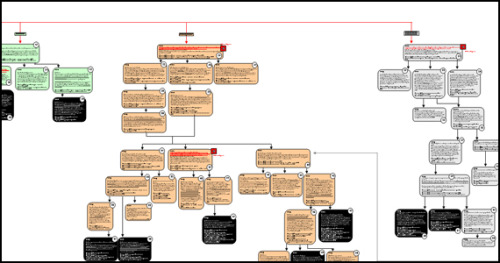
The game is based in mobile text messages. So we needed to create a script with information architecture basis; the script of the game is made of what we can call “decision trees”.

This is very simple to understand: it’s very similar to an old role playing game book. You read a paragraph and the text shows you a bunch of options to go ahead in the narrative.

For instance:

“Detective, you are in front of the university. What are you going to do? Option 1: enter the building; Option 2: search for clues around; 3) Option 3: try to enter the back door”

So each chapter of the game (and we made five chapters) looks like this:

As a promotional game, it is important to create points in the narrative where we can offer pay services from the mobile company. So, we decided to put – as a help to the players – hints and tips of the game that the player can buy using services and other tools of the company.

The great challenge here is to create a game based only in limited text (because each message needed to have a maximum of 138 characters) and build an immersive and fun narrative to get the player inside the story.

This promotion had a great audience. Around 2 million of people participating in it, making it a successful Brazilian case.

It was a great challenge to create this game because of his limitations. But I think that limitations are an important piece of the game design process.

And you? What do think about that?

Twitter

Competition