
 :.
:.


Showing posts with label game designer. Show all posts
Showing posts with label game designer. Show all posts
Top Ten Tips for Boardgame Designers
Good stuff from the Dice Tower site. Tom Vasel, Zee Garcia, and Sam Healey give advice to aspiring boardgame designers. Have fun!
Recap for everybody:
10. Do your Research;
9. You will not make much money;
8. No one is going to steal your brilliant idea;
7. Be inspired by other game, do not just copy them;
6. Match your theme with the game mechanics;
5. Listen to developer and publisher, they want your game to succeed;
4. Streamline your game, remove unnecessary aspects (keep it fun);
3. Listen to your play testers, but don't design by committee (it's your game);
2. Design the game your way, there is no "one way" to do it;
1. Play test your game along the way! (use honest people who aren't afraid to hurt your feelings).
Recap for everybody:
10. Do your Research;
9. You will not make much money;
8. No one is going to steal your brilliant idea;
7. Be inspired by other game, do not just copy them;
6. Match your theme with the game mechanics;
5. Listen to developer and publisher, they want your game to succeed;
4. Streamline your game, remove unnecessary aspects (keep it fun);
3. Listen to your play testers, but don't design by committee (it's your game);
2. Design the game your way, there is no "one way" to do it;
1. Play test your game along the way! (use honest people who aren't afraid to hurt your feelings).
Tuesday, October 29, 2013
// 0 comments
Knowledge for game designers
"Do weird and difficult things" — Masaya Matsuura, Game Designer.
"Focus groups tell you what people like, but they don't tell you what people want" — Ron Gilbert, Game Designer.
"Play testing by people outside of the development team typically comes too late to have a major impact on the final product" — Jeff Orkin, Game Researcher.
"What game is worth doing that's not creatively risky?" — Tim Schafer, Game Designer
Source: Quotes for game designers
"Focus groups tell you what people like, but they don't tell you what people want" — Ron Gilbert, Game Designer.
"Play testing by people outside of the development team typically comes too late to have a major impact on the final product" — Jeff Orkin, Game Researcher.
"What game is worth doing that's not creatively risky?" — Tim Schafer, Game Designer
Source: Quotes for game designers
Wednesday, July 3, 2013
// 0 comments
About Jane McGonigal presentation at Cannes Lions 2013
Few days ago I was in France at the Cannes Festival of Creativity (A.K.A Cannes Lions Festival) and watched an awesome presentation by Jane McGonigal, an American game designer and author who advocates for the use of mobile and digital technology to channel positive attitudes and collaboration, in a real world context.
Jane talked about how games could change the quotidian and bring positive effects to the contemporary world. The author also spoke about how games make us resilient and could be used in non-gaming context.

McGonigal brought an excellent case to the audience about how, in clinical trials, casual games outperform pharmaceuticals for anxiety, depression and other health disturbers. To illustrate that interface between games and healthcare, Jane used as an example the game Re-Mission (HopeLab, 2006). In that game the player is inside the bloodstream of a cancer patient as his/her mission is to destroy the cancer cells with a special weapon. The video below shows the gameplay of Re-Mission:
This game is used in the treatment of children with cancer. As Jane said, in the behavioral side the patients tend to have better chemotherapy adherence (20% higher blood chemo levels), and in the psychological side patients tend to have higher rates of self-efficacy.
There’s so much to research in this area but I think authors like Jane McGonigal are doing a great job.
And I recommend the book “The reality is broken” from this author to start a new discussion about the use of ludic interfaces in non-game contexts like health, politics, serious causes and education.
Jane talked about how games could change the quotidian and bring positive effects to the contemporary world. The author also spoke about how games make us resilient and could be used in non-gaming context.
McGonigal brought an excellent case to the audience about how, in clinical trials, casual games outperform pharmaceuticals for anxiety, depression and other health disturbers. To illustrate that interface between games and healthcare, Jane used as an example the game Re-Mission (HopeLab, 2006). In that game the player is inside the bloodstream of a cancer patient as his/her mission is to destroy the cancer cells with a special weapon. The video below shows the gameplay of Re-Mission:
This game is used in the treatment of children with cancer. As Jane said, in the behavioral side the patients tend to have better chemotherapy adherence (20% higher blood chemo levels), and in the psychological side patients tend to have higher rates of self-efficacy.
There’s so much to research in this area but I think authors like Jane McGonigal are doing a great job.
And I recommend the book “The reality is broken” from this author to start a new discussion about the use of ludic interfaces in non-game contexts like health, politics, serious causes and education.
Wednesday, June 26, 2013
// 0 comments
The relationship among achievements, rewards, and power

Source:
ADAMS, Ernest. Fundamentals of Game Design. New Riders: 2009. p.385
Tuesday, April 30, 2013
// 0 comments
Essential questions to answer during a game design process
Regardless of the platform, every gaming project has some common elements that need special attention. The authors of the book Game Design (reference at the end of the post) created a good list of essential questions (2007, p.86-87) to a game design project.

These questions are important in order to give you a concept form as a game and avoid a poorly defined idea. Let’s check this useful content:
1.Can you describe the game concisely in one paragraph? Keep in mind that you need to explain the main idea of the game in less than 30 seconds. Try to describe your favorite games in one paragraph to exercise.
2.Can you summarize the story? You can find excellent references on the back cover of video game cases.
3.Which platform? Playstation or card game? Xbox or board game? Remember: a good idea can be multi-platform, sometimes.
4.Does it fit a genre? First Person Shooter, puzzle, 2D platform, survival horror, etc. What kind of game we are talking about?
5.What’s the target audience? There’s a difference between creating a horror game for adults and an puzzle game for children. You need to knowyour target audience deeply. This is very important: you’ll create a game for a specific audience, not for you.
Think about that in your next game design project.
Reference:
THOMPSON, Jim; BERBANK-GREEN, Barnaby; CUSWORTH, Nic. Game Design: principles, practice, and techniques - the ultimate guide for the aspiring game designer. New Jersey: Wiley, 2007
These questions are important in order to give you a concept form as a game and avoid a poorly defined idea. Let’s check this useful content:
1.Can you describe the game concisely in one paragraph? Keep in mind that you need to explain the main idea of the game in less than 30 seconds. Try to describe your favorite games in one paragraph to exercise.
2.Can you summarize the story? You can find excellent references on the back cover of video game cases.
3.Which platform? Playstation or card game? Xbox or board game? Remember: a good idea can be multi-platform, sometimes.
4.Does it fit a genre? First Person Shooter, puzzle, 2D platform, survival horror, etc. What kind of game we are talking about?
5.What’s the target audience? There’s a difference between creating a horror game for adults and an puzzle game for children. You need to knowyour target audience deeply. This is very important: you’ll create a game for a specific audience, not for you.
Think about that in your next game design project.
Reference:
THOMPSON, Jim; BERBANK-GREEN, Barnaby; CUSWORTH, Nic. Game Design: principles, practice, and techniques - the ultimate guide for the aspiring game designer. New Jersey: Wiley, 2007
Tuesday, April 2, 2013
// 0 comments
Level Design
I'm an old school gamer. I started my gaming activities in the early eighties with the Atari console and pocket electronic games. Since then, I've played a lot of games in many different platforms, and there's a common element in all these games that attracts my attention: the "level design".
From simple to complex games, level designing is an important piece and essential component for a good (and immersive) experience to the player.

(Image source: BarryHevan's Game Design Blog)
As Adams and Rollings point out, level design is the process of building the experience that will be offered directly to the player, using components provided by the game designer. Level designers create the space in which the game takes place, the initial conditions of the level, the set of challenges the player will face within the level, the termination conditions of it, the interplay between the gameplay and the game’s story and the aesthetics of the level. (2007, p.399 & 400).
As Fullerton says, games that are organized into levels will need someone to actually design and implement each level. If your project is very small, you might design all the levels yourself. On a larger project, however, the game designer often leads a team of level designers who implement their concepts for the various game levels, and sometimes come up with ideas for levels themselves. And an important point: level designers use a toolkit or “level editor” to develop new missions, scenarios, or quests for the players (2008, p.361 & 362).
The Pac Man game for Atari (1982) has only one level. The ghosts get faster as each stage ends, but the maze is still the same. On the other hand, the God of War game for Playstation (2005) has huge screens where there are multiple challenges and a more complex level design with puzzles and many enemies.
An important point to highlight is: games can have simple level design and be as good as extremely complex games. Remember: the focus is on the player and how much fun he or she gets from the game.
References:
ADAMS, Ernest; ROLLINGS, Andrew. Fundamentals of Game Design. New Jersey: Pearson Prentice Hall, 2009
FULLERTON, Tracy; SWAIN, Christopher; HOFFMAN, Steven. Game design workshop: a playcentric approach to creating innovative games. Burlington: Morgan Kaufmann Publishers, 2008.
From simple to complex games, level designing is an important piece and essential component for a good (and immersive) experience to the player.
(Image source: BarryHevan's Game Design Blog)
As Adams and Rollings point out, level design is the process of building the experience that will be offered directly to the player, using components provided by the game designer. Level designers create the space in which the game takes place, the initial conditions of the level, the set of challenges the player will face within the level, the termination conditions of it, the interplay between the gameplay and the game’s story and the aesthetics of the level. (2007, p.399 & 400).
As Fullerton says, games that are organized into levels will need someone to actually design and implement each level. If your project is very small, you might design all the levels yourself. On a larger project, however, the game designer often leads a team of level designers who implement their concepts for the various game levels, and sometimes come up with ideas for levels themselves. And an important point: level designers use a toolkit or “level editor” to develop new missions, scenarios, or quests for the players (2008, p.361 & 362).
The Pac Man game for Atari (1982) has only one level. The ghosts get faster as each stage ends, but the maze is still the same. On the other hand, the God of War game for Playstation (2005) has huge screens where there are multiple challenges and a more complex level design with puzzles and many enemies.
An important point to highlight is: games can have simple level design and be as good as extremely complex games. Remember: the focus is on the player and how much fun he or she gets from the game.
References:
ADAMS, Ernest; ROLLINGS, Andrew. Fundamentals of Game Design. New Jersey: Pearson Prentice Hall, 2009
FULLERTON, Tracy; SWAIN, Christopher; HOFFMAN, Steven. Game design workshop: a playcentric approach to creating innovative games. Burlington: Morgan Kaufmann Publishers, 2008.
Thursday, January 31, 2013
// 0 comments
Quote of the day
"Like novels, games don't come out of the blue. They come from a given designer, at a given time, in a given social situation".
Bruno Faidutti, in Appelcline, 2006 (Excerpted from the book "Eurogames: The Design, Culture and Play of Modern European Board Games").
Bruno Faidutti, in Appelcline, 2006 (Excerpted from the book "Eurogames: The Design, Culture and Play of Modern European Board Games").
Tuesday, January 15, 2013
// 0 comments

'Mum, Dad, I want to be a Game Designer'
This is a presentation made at the SAND, (Swansea International Animation Festival), in November 2008 (little bit old but is very good), by the Global Head of Employment Brand, Matthew Jeffery. In this video here about game design, what game designers do and what skills you need to be one. As this video is of a complete presentation made it is 50 mins long.
What do you think about that?
What do you think about that?
Friday, August 10, 2012
// 0 comments
Hints & tips for a good game prototype – Part I (card game)
By Vince
A good idea for a game needs a good prototype. In the first tests of your game is totally understandable the use of sketches, roughs and non-finished materials, but a formal presentation to a publisher needs more care.
In this post I´ll talk about analogical prototype. More precisely how to create a card game prototype.
I like to create cards in three layers of paper:
1) First layer: the back from the card (with some kind of pattern or the logotype of the game) printed with laser jet in a good opaque paper;
2) Second layer: I like to put a middle layer using a thick paper. It’s important to maintain your card resistant and plain;
3) Third layer: the front of the card with the content of the game in the same way of the first layer.
Check the diagram below:

In the end it’s important to keep your cards protected from physical damage. I strongly recommend putting the cards inside plastic protector sleeves.
Your game will look more professional and your idea certainly will be clearer to the publisher or your beta test group.
Szia.
A good idea for a game needs a good prototype. In the first tests of your game is totally understandable the use of sketches, roughs and non-finished materials, but a formal presentation to a publisher needs more care.
In this post I´ll talk about analogical prototype. More precisely how to create a card game prototype.
I like to create cards in three layers of paper:
1) First layer: the back from the card (with some kind of pattern or the logotype of the game) printed with laser jet in a good opaque paper;
2) Second layer: I like to put a middle layer using a thick paper. It’s important to maintain your card resistant and plain;
3) Third layer: the front of the card with the content of the game in the same way of the first layer.
Check the diagram below:
In the end it’s important to keep your cards protected from physical damage. I strongly recommend putting the cards inside plastic protector sleeves.
Your game will look more professional and your idea certainly will be clearer to the publisher or your beta test group.
Szia.
Monday, May 7, 2012
// 0 comments
Story of my (game designer) life
A long time ago in the city of São Paulo (Brazil), around 14 years in the past, there was a great Comic & RPG encounter happening. I was in the event with a bunch of good nerd friends.
At the time we had the opportunity to attend a presentation of the author Michael Mulvihill, best known for publishing awesome RPG books like "Shadowrun" and "Battletech", which, by the way, were part of my adolescence.
I watched the presentation of Mr. Mulvihill, which proved extremely inspiring for all those who were there, and wanted to give life to their own games.
When the lecture ended, I asked for an autograph and asked him a question: "Mr. Mulvihill, what is required to be a good game designer? ". And he answered me:

Years later, I've found this paper inside an old drawer and realized how much truth there was in those words. I think the idea is to play games, experience games and interact with ludic interfaces all the time. The message of Mr. Mulvihill is about getting good references and repertoire because this is essential to create good gaming projects.
So we can apply these concepts in several areas of knowledge and create good experiences.
So, play games and have fun.
At the time we had the opportunity to attend a presentation of the author Michael Mulvihill, best known for publishing awesome RPG books like "Shadowrun" and "Battletech", which, by the way, were part of my adolescence.
I watched the presentation of Mr. Mulvihill, which proved extremely inspiring for all those who were there, and wanted to give life to their own games.
When the lecture ended, I asked for an autograph and asked him a question: "Mr. Mulvihill, what is required to be a good game designer? ". And he answered me:
Years later, I've found this paper inside an old drawer and realized how much truth there was in those words. I think the idea is to play games, experience games and interact with ludic interfaces all the time. The message of Mr. Mulvihill is about getting good references and repertoire because this is essential to create good gaming projects.
So we can apply these concepts in several areas of knowledge and create good experiences.
So, play games and have fun.
Tuesday, April 24, 2012
// 0 comments
Game Design Exercises
By Vince
The idea of this post is present two game design exercises. I want to entice the audience of my blog to create new games from classical game mechanics. It can be difficult in a first moment but don’t put a muzzle in your creativity; slight changes in traditional game mechanics could generate something new and fun.
The first exercise is from a very good book named “Challenges for Game Designers” and the challenge proposed is: try to create a TIC-TAC-TOE for three players. You can modify rules and put new elements (like cards or dice) but the core of the game must be the same. Try to make a digital or analogical prototype of your game.

Following the previous idea, in the second exercise I want to propose the creation of a new dynamic for the classic game PONG. I’ve made this exercise and created the PONT, a solitary flash game. Check the project online (link here).
In my version of PONG there are two basic modifications:
1) the ball is an asterisk that changes color all the time (sometimes the color of the ball is very similar to the background color) and the player needs to pay double attention to the interface.
2) the racket horizontally changes size and does a wave movement (up and down) all the time. It’s another factor that requires more concentration from the player.
The image below shows these features of the game:

And let’s work! I’ll be glad if the exercises help you having new ideas and build good prototypes. Make yourself comfortable to send me your ideas in the mail vincevader@gmail.com.
•REFERENCES:
BRATHWAITE, Brenda & SCHREIBER, Ian. CHALLENGES FOR GAME DESIGNERS: non-digital exercises for vídeo game designers. USA: Cengage, 2009.
The idea of this post is present two game design exercises. I want to entice the audience of my blog to create new games from classical game mechanics. It can be difficult in a first moment but don’t put a muzzle in your creativity; slight changes in traditional game mechanics could generate something new and fun.
The first exercise is from a very good book named “Challenges for Game Designers” and the challenge proposed is: try to create a TIC-TAC-TOE for three players. You can modify rules and put new elements (like cards or dice) but the core of the game must be the same. Try to make a digital or analogical prototype of your game.
Following the previous idea, in the second exercise I want to propose the creation of a new dynamic for the classic game PONG. I’ve made this exercise and created the PONT, a solitary flash game. Check the project online (link here).
In my version of PONG there are two basic modifications:
1) the ball is an asterisk that changes color all the time (sometimes the color of the ball is very similar to the background color) and the player needs to pay double attention to the interface.
2) the racket horizontally changes size and does a wave movement (up and down) all the time. It’s another factor that requires more concentration from the player.
The image below shows these features of the game:
And let’s work! I’ll be glad if the exercises help you having new ideas and build good prototypes. Make yourself comfortable to send me your ideas in the mail vincevader@gmail.com.
•REFERENCES:
BRATHWAITE, Brenda & SCHREIBER, Ian. CHALLENGES FOR GAME DESIGNERS: non-digital exercises for vídeo game designers. USA: Cengage, 2009.
Thursday, April 19, 2012
// 0 comments
Goals and rewards
By Vince
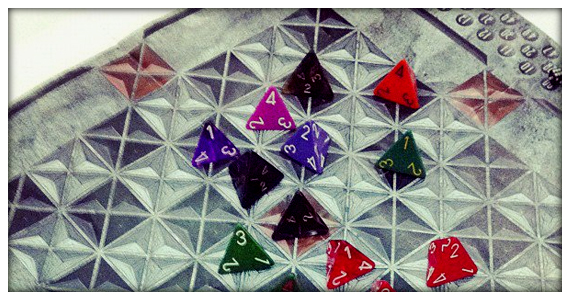
At this moment I'm working on my new board game named PYRAMYZ, a dice game that uses D4s as paws in an orthogonal board. I hope to cast this game by April or May of this year. I intend to write a complete review of the creative process of this new game after the launching, very similar to the review of my other board game named YN (link here).
While the production of the game is not finished I want to discuss an important point of the game design process: the creation of a logical goal/reward to the game mechanics. In the moment of conception of a new game, it is very common to think about components, complex mechanics, layout, and sometimes we forget to create a good and clear goal/reward to offer the players.
The goal of my new game is simple: to be the player with most victory points. And how can You get victory points? Putting the higher values of D4 dices in the squares of your color in the board. It's possible to have an idea in the image below:
 In the book “Game Design: principles, practice, and tecniques - the ultimate guide for the aspiring game designer” there is a good view about this subject. The authors say:
“A crucial aspect of a game is that has a definite goal, and reaching this usually allows an individual to win. Goals can include eliminating the other player(s) from the game, achieving an identified target (for example by amassing a number of points), winning a race, or collecting a certain type of token.
Achieving the goal - winning - can be its own reward. A player may have defeated his opponent through his superior game-playing skill or he may simply have been lucky with random factors.
Many modern games, digital and non-digital, do not rely on winning as the sole reward but are designed so that all of the players can derive some enjoyment from the process of playing the game”. (page 13)
Another good gaming concept! What do you think about that?
Reference:
THOMPSON, Jim; BERBANK-GREEN, Barnaby; CUSWORTH, Nic. Game Design: principles, practice, and tecniques - the ultimate guide for the aspiring game designer. New Jersey: Wiley, 2007
At this moment I'm working on my new board game named PYRAMYZ, a dice game that uses D4s as paws in an orthogonal board. I hope to cast this game by April or May of this year. I intend to write a complete review of the creative process of this new game after the launching, very similar to the review of my other board game named YN (link here).
While the production of the game is not finished I want to discuss an important point of the game design process: the creation of a logical goal/reward to the game mechanics. In the moment of conception of a new game, it is very common to think about components, complex mechanics, layout, and sometimes we forget to create a good and clear goal/reward to offer the players.
The goal of my new game is simple: to be the player with most victory points. And how can You get victory points? Putting the higher values of D4 dices in the squares of your color in the board. It's possible to have an idea in the image below:
 In the book “Game Design: principles, practice, and tecniques - the ultimate guide for the aspiring game designer” there is a good view about this subject. The authors say:
“A crucial aspect of a game is that has a definite goal, and reaching this usually allows an individual to win. Goals can include eliminating the other player(s) from the game, achieving an identified target (for example by amassing a number of points), winning a race, or collecting a certain type of token.
Achieving the goal - winning - can be its own reward. A player may have defeated his opponent through his superior game-playing skill or he may simply have been lucky with random factors.
Many modern games, digital and non-digital, do not rely on winning as the sole reward but are designed so that all of the players can derive some enjoyment from the process of playing the game”. (page 13)
Another good gaming concept! What do you think about that?
Reference:
THOMPSON, Jim; BERBANK-GREEN, Barnaby; CUSWORTH, Nic. Game Design: principles, practice, and tecniques - the ultimate guide for the aspiring game designer. New Jersey: Wiley, 2007
Monday, March 5, 2012
// 0 comments
Simple and elegant: the essence of game design
Two days ago I've visited (again) a video game exhibition in my city (São Paulo) named GAME ON. There's a lot of good stuff in the place from all periods of the history of video games.
From ATARI till Xbox 360 with Kinect the exhibition gives to us a complete panorama of evolution, technology, design, language, mechanics and market in the video games universe.
The visit inspired myself to write this post. I've played a lot of classics of my childhood in the fair: Pitfall (ATARI, Activison, 1985), Space Invaders (Arcade, Taito, 1978), Donkey Kong (Arcade, Nintendo, 1981), Pac Man (Arcade, Namco, 1980) and many others in different platforms.
But I want to talk about a particular one. I want to talk about PONG, one of the first well succeed games in the history and a game with a great importance in the contemporary scene of communication. PONG is part of a series of experiments in which people began to interact with screens and became more than mere spectators.
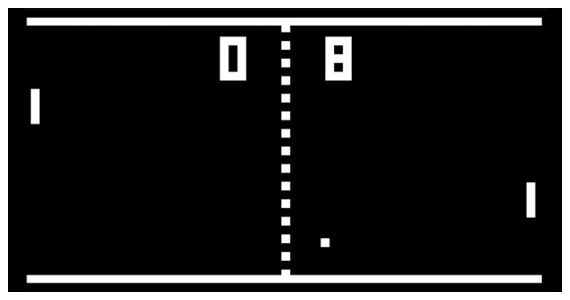
 PONG it´s an example of simple and elegant game design. It´s simple because there´s only one rule printed in the arcade: "avoid missing ball for high score" and it´s elegant by the minimalist design/idea of a table tennis made with few elements in the screen.
Salen and Zimmerman in the preface of the book Rules of Play (page XIII and XIV) explain why PONG is a successful game. The authors explain that the game despite its almost primitive simplicity, creates meaningful play. PONG is simple to play, every game is unique, it´s social (requires two players to play) and finally it´s fun and cool.
PONG still alive today. We can see the idea and mechanics of this game in new versions, new layout, internet ads and a lot of other places. PONG is a proof that good game design can survive the time.
And you? What do you think about that?
Game over! =)
Reference:
SALEN, Katie & ZIMMERMAN, Eric. Rules of Play: game design fundamentals. Massachusetts; The MIT Press, 2004
From ATARI till Xbox 360 with Kinect the exhibition gives to us a complete panorama of evolution, technology, design, language, mechanics and market in the video games universe.
The visit inspired myself to write this post. I've played a lot of classics of my childhood in the fair: Pitfall (ATARI, Activison, 1985), Space Invaders (Arcade, Taito, 1978), Donkey Kong (Arcade, Nintendo, 1981), Pac Man (Arcade, Namco, 1980) and many others in different platforms.
But I want to talk about a particular one. I want to talk about PONG, one of the first well succeed games in the history and a game with a great importance in the contemporary scene of communication. PONG is part of a series of experiments in which people began to interact with screens and became more than mere spectators.
 PONG it´s an example of simple and elegant game design. It´s simple because there´s only one rule printed in the arcade: "avoid missing ball for high score" and it´s elegant by the minimalist design/idea of a table tennis made with few elements in the screen.
Salen and Zimmerman in the preface of the book Rules of Play (page XIII and XIV) explain why PONG is a successful game. The authors explain that the game despite its almost primitive simplicity, creates meaningful play. PONG is simple to play, every game is unique, it´s social (requires two players to play) and finally it´s fun and cool.
PONG still alive today. We can see the idea and mechanics of this game in new versions, new layout, internet ads and a lot of other places. PONG is a proof that good game design can survive the time.
And you? What do you think about that?
Game over! =)
Reference:
SALEN, Katie & ZIMMERMAN, Eric. Rules of Play: game design fundamentals. Massachusetts; The MIT Press, 2004
Tuesday, December 13, 2011
// 0 comments
Games and movies. Movies and games.
A few posts ago (click here to read) I've published an interesting point of view about the key difference between games and movies in the words of the game designer Sid Meier.
In this post I want to highlight this idea with some quotations from the book Video Gane Spaces. In the words of Nitsche (page 57) the filmmaker says, 'Look, I'll show you.' The spacemaker says, 'Here, I'll help you discover'. And Jenkins suggests that we should "think of game designers less as storytellers than as narrative architects" (page 129) who "don´t simply tell stories; they design worlds and sculpt spaces" (ibid., 121).
In this post I want to highlight this idea with some quotations from the book Video Gane Spaces. In the words of Nitsche (page 57) the filmmaker says, 'Look, I'll show you.' The spacemaker says, 'Here, I'll help you discover'. And Jenkins suggests that we should "think of game designers less as storytellers than as narrative architects" (page 129) who "don´t simply tell stories; they design worlds and sculpt spaces" (ibid., 121).
I really like the idea of denominate the game designer a kind of spacemaker. In fact we are talking about spaces with interactions, rules and players.
Despite the differences is undeniable that the films strongly influence the games. And it is undeniable that games also greatly influence the films.
 In a future post I want to discuss this aspect. I want to talk about the dynamics of how movies become games (eg Iron Man) and how games become movies (eg Silent Hill).
 In a future post I want to discuss this aspect. I want to talk about the dynamics of how movies become games (eg Iron Man) and how games become movies (eg Silent Hill).
See you!
References:
NITSCHE, Michael. VIDEO GAME SPACES - image, play and structure in 3D worlds. Massachusetts: MIT Press, 2008.
JENKINS, Henry."Game Design as Narrative Architecture" In First Person: New Media as Story, Performance and Game, edited by Pat Harrington and Noah Wardrup-Fruin, 118-131. Cambridge, MA, and London: MIT Press, 2004.
References:
NITSCHE, Michael. VIDEO GAME SPACES - image, play and structure in 3D worlds. Massachusetts: MIT Press, 2008.
JENKINS, Henry."Game Design as Narrative Architecture" In First Person: New Media as Story, Performance and Game, edited by Pat Harrington and Noah Wardrup-Fruin, 118-131. Cambridge, MA, and London: MIT Press, 2004.
Wednesday, December 7, 2011
// 0 comments
A good quote for today
"Playing a game is a voluntary attempt to overcome unnecessary obstacles" - Bernard Suits (in The Grasshopper: Games, Life and Utopia)
Saturday, December 3, 2011
// 0 comments
Interview with game designer Reiner Knizia (DIGRA 2011)
Games need to reflect our high-paced way of life. That’s what Reiner Knizia thinks. And if there’s someone who knows about these things, it’s Knizia. He designed over 200 games. Mostly board games, for which he received numerous awards. Submarine Channel talked to the enthusiastic game designer about the new dynamics of today’s games.
This interview was recorded at the THINK DESIGN PLAY // 5th DiGRA Conference on games and play, 2011.
Board game designer Reiner Knizia interview from SubmarineChannel on Vimeo.
This interview was recorded at the THINK DESIGN PLAY // 5th DiGRA Conference on games and play, 2011.
Tuesday, November 22, 2011
// 0 comments
Sid Meier speaks
"There's a key difference between games and movies. In a game, the more attention that's focused on the player, the more successful it is. In a movie, you're really watching somebody else's story, so the better the story or the better the actor, the more interested you are in the movie. In a game, the more interesting you are as a player, the more successful the game is. So, in a way, things that work in movies are designed to impress you with what somebody else is doing. A good game impresses you with what you're doing. I think that's a fundamental difference that I as a game designer need to recede in the background. The more the player is thinking about the design or the designer, the less successful I've been, because I want the player to forget somebody designed this game, forget that this is a game, and believe that this is an experience that the player is having. Whereas in a movie, the more you're aware of the director or the stars, the more you're impressed with them - that helps the movie to be successful. In a way, trying to impress people with design or personality or whatever works to promote movies doesn't work with games because it takes the focus off the player who is supposed to be the star. The more the player is the star, the better a game you have."
Sid Meier*
*Sidney K. "Sid" Meier (born February 24, 1954) is a Canadian programmer and designer of several popular computer strategy games, most notably Civilization. He has won accolades for his contributions to the computer games industry.
Sid Meier*
*Sidney K. "Sid" Meier (born February 24, 1954) is a Canadian programmer and designer of several popular computer strategy games, most notably Civilization. He has won accolades for his contributions to the computer games industry.
Thursday, November 17, 2011
// 0 comments
Essential books about game design & gaming concepts - EPISODE I
I want to share some of my favorites books about games in this post, so I've created a first list with ten good titles. There are good references to academic research and how to create games. In the end of each topic of this post there´s a link to Google Books with previews. Enjoy and send me new suggestions.

•Fundamentals of game design by Ernest Adams. (link)
•Challenges for game designers by Brenda Brathwaite, Ian Schreiber. (link)
•A theory of fun for game design by Raph Koster. (link)
•Game design workshop: a playcentric approach to creating innovative games by Tracy Fullerton, Christopher Swain & Steven Hoffman. (link)
•Casual Game Design: Designing Play for the Gamer in ALL of Us by Gregory Trefry. (link)
•Half-real: video games between real rules and fictional worlds by Jesper Juul. (link)
•Game writing: narrative skills for videogames by Chris Mark Bateman. (link)
•Extra Lives: Why Video Games Matter by Tom Bissell. (link)
•The Ultimate Guide to Video Game Writing and Design by Flint Dille & John Zuur Platten. (link)
•Fundamentals of game design by Ernest Adams. (link)
•Challenges for game designers by Brenda Brathwaite, Ian Schreiber. (link)
•A theory of fun for game design by Raph Koster. (link)
•Game design workshop: a playcentric approach to creating innovative games by Tracy Fullerton, Christopher Swain & Steven Hoffman. (link)
•Casual Game Design: Designing Play for the Gamer in ALL of Us by Gregory Trefry. (link)
•Half-real: video games between real rules and fictional worlds by Jesper Juul. (link)
•Game writing: narrative skills for videogames by Chris Mark Bateman. (link)
•Extra Lives: Why Video Games Matter by Tom Bissell. (link)
Sunday, November 6, 2011
// 0 comments
Subscribe to:
Posts (Atom)