Showing posts with label jesper juul. Show all posts

Interview with Jesper Juul

This week we have a special post on Gaming Conceptz. Jesper Juul, the video game theorist, gave this blog a special interview. I had the honor of meeting the author last year at the F.R.O.G (Future and Reality of Gaming) Conference. Enjoy the content! Thank you so much Mr. Juul. May the force be with you. =)


Bio: Jesper Juul is a video game theorist and associate professor at the Royal Danish Academy of Fine Arts - The School of Design, and a visiting associate professor at Comparative Media Studies/Writing at MIT. He has been working with video game theory since the early 1990s, at the IT University of Copenhagen, MIT, and at New York University. His previous books are the video game theory classic Half-Real and A Casual Revolution. He recently published The Art of Failure, a book that combines personal confessions about failure with philosophy, game design analysis, psychology and fiction theory.


1) In your last book 'The Art of Failure' you talk about 'the pain of playing video games' in a very interesting way. What was your primary inspiration source to write about this subject?
Two things: 1) That our interaction with video games is clearly filled with frustration and unhappiness, yet we tend to talk about video games in purely positive terms - good, great, awesome, deep etc.. Why are we not talking about this darker side of game playing, and why do we play games even though it is there? 2) My personal experience as a very sore loser of all types of games. Losing makes me very frustrated, yet why is losing so important to me?

2) 'The Art of Failure' is about video games. Can we use the same ideas for board games and card games?
I used mostly video games as examples, but most of the discussion applies to all games. Video games then add some particular twists, especially in terms of single-player games, where the designer can closely follow the progress of the player and tweak the difficult and failure rates to match the player's current skill level.

3) In your keynote at F.R.O.G. 2013, you talked a little bit about "Gamification". This buzzword became very popular recently. What do you think about this buzzword? Do you think it's a good concept to define the use of game elements in non-game activities? Do you think it's correct to use 'game thinking' instead?
Like most buzzwords, gamification is overused, overhyped etc.. We could try to introduce a different term, but I think we should rather try to live with "gamification" and then explain what its problems are, what the advantages are etc.. I.e. the important thing is not the word itself, but what we use the ideas for, and how we implement them.

Gamification is a good idea in some activities.

It works best for situations where users / students / employees are in need of feedback, and when the gamification system allows the user to exercise sound judgment.

It works very badly in situations where users are meant to be creative, or if they are already deeply, personally committed to doing the best job that they possibly can. In such situations, gamification can become deeply demotivating.

We could call this the paradox of gamification: we associate games with fun and freedom, yet if we implement the wrong kind of gamification system, it becomes 1984, instead, by closely monitoring and punishing everybody who deviates from the path decided by the leaders.

4) The world is going mobile. How do you see the field of mobile gaming for the next years?
For a while, it seemed that traditional games would keep playing on consoles and PCs, and the broader public would be playing on mobile devices. But now this division seems to have almost disappeared. I think we will continue to see more, "deeper" game experiences on mobile devices.

For phones and tablets, the question to me is still whether external controllers will at some point become mainstream.

5) What are you playing at this moment?
My summer playing has mostly been Clash of Clans - there is something deeply compelling about the strategic multiplayer clan experience.

6) Send a final message to the new researchers of the gaming studies field.
There are many, many things that we don't understand about games, players, development and so on. What is the question that you are in a unique position to formulate and then answer?

Casual games for casual players

Today’s post is about one of my favorite subjects: casual game design. Undoubtedly, the contemporary multiplatform environment, with so many connections between different devices, becomes a privileged ambient for games, especially casual games.

Casual games are everywhere: in the console, in the smartphone/tablet, inside Facebook and even in analogical card/board games.


To discuss some essential points about casual game design, we bring Jesper Juul into the discussion. In his awesome book Casual Revolution (2010), Juul points out (2013, p.50) that casual game design has five components:

1.Fiction: “The player is introduced to the game by way of a screenshot, a logo on a web page, or the physical game box”.

2.Usability: “The player tries to play the game, and may or may not have trouble understanding how to play”.

3.Interruptibility: “A game demands a certain time commitment from the player. It is not that casual games can only be played for short periods of time (…)”

4. Difficulty and punishment: “A game challenges and punishes the player for failing. Casual games often become very difficult during the playing of a game, but they do not force the player to replay large parts of the game.”

5. Juiciness: “Though this was not predicted by the description of casual players, casual game design commonly features excessive positive feedback for every successful action the player performs.”

All these topics help us think how to develop better games and – in some way – how to reinvent video games for a broader audience.


Reference:

JUUL, Jesper. A casual revolution. Cambridge: The MIT Press, 2010.

Types of failure in games

Recently, I finished the awesome book by Jesper Juul named “The Art of Failure”. This book is a great inspiration for game designers, game researchers and game lovers of all platforms. The idea about the “the pain of playing video games” gives us a new view on failure and on how to create entertainment from it (which is considered a bad thing in the real world).


There are two details I want to bring into this discussion right now: the first one is about the two types of failure. As Jull says (2013, p.25) we can find the “real failure” and the “fictional failure”: the “real failure occurs when a player invests time into playing a game and fails” and the “fictional failure is what befalls the character(s) in the fictional game world” *SPOILER ALERT* (Like in Red Dead Redemption. You need to die with John Marston to continue the narrative).

The second point to highlight is about the idea that we are “emotionally affected by games, and we are aware of this before we start playing” (JUUL, 2013, p.56). This means that games arouse feelings in players and can create a strange connection during the gaming experience working with feelings like happiness, anger, frustration, fear etc. To understand the interface between the game and the player’s emotions is a great step to create new kinds of gaming experiences. Maybe a new door to be opened to new sensations inside the ludic universe.


References:

JUUL, Jesper. The Art of Failure: an essay on the pain of playing video games. Cambridge/London: MIT Press, 2013.

The art of making friendly enemies

I participate in a group called Board Game Tuesday (or BGT). We meet weekly to play and discuss board games. Our primary focus is the playing, but we always set aside a time to analyze the structure of the games (mechanics, dynamics, art, components etc.).

However, I quite like to analyze the behavior of players during matches. I like to observe the nervousness to roll the dice for something important, the glory in the eyes of a player with a well-structured combo of cards, the malignant partnerships between players and – of course – arguments and "fights" because of the final results of a gaming experience.


(Playing ISLA DORADA. Big, Vince & Snow. Pic: Estevão)

This last feature, particularly, impresses me. The “magic circle” of a game has the power to transform friends in enemies with established social rules (and gaming rules). As Juul says (2013, p.11) “when playing a game, a number of actions that would regularly be awkward and rude are recast as pleasant and sociable”. So, we can say that a game can generate a kind of friendly enemies during the time of a match.

About this context Juul (2013, p.14) also says that, to play a game is “to make an emotional gamble: we invest time and self-esteem in the hopes that it will pay off. Players are not willing to run the same amount of risk – some even prefer not to run a risk at all, not to play”.

The gaming ecosystem is a complex and privileged field of studies. But we must never forget that behind a game there are human players full of feelings and this is an important part of the experience to observe, analyze and discuss.

At this moment, I’m reading again Jesper Juul’s “The Art of Failure” and Bernad Suits “The Grasshopper”. I’m full of new ideas about the role of the player inside the gaming universe and I count on this inspiration for a “wave” of posts with this subject this semester.

Keep your radars alert for that.


Reference
:

JUUL, Jesper. The Art of Failure: an essay on the pain of playing video games. Cambridge/London: MIT Press, 2013.

SUITS, Bernard. The Grasshopper: Games, Life and Utopia. EUA: Broadview Press, 2005.

The delicate balance between challenges, narrative and rules

At this moment I’m playing again ALAN WAKE (Xbox 360, Remedy Entertainment /Microsoft Game Studios, 2010). The game is a third person psychological horror thriller about novelist Alan Wake, as he tries to uncover the mystery behind his wife's disappearance, during a vacation in the small fictional town of Bright Falls. During the game, Alan is transported to a kind of dark dimension where stories from his horror books become real.

The game is one of my favourites and it offers an awesome experience to the player with a perfect blend between the puzzles/challenges/enemies, the narrative and the rules/mechanics.


In ALAN WAKE the ammo is limited, the creatures are in great number and, frequently, you need to run instead of fight. The game dynamics creates an atmosphere of tension all the time and in the end of each chapter you can relax a little bit enjoying the game's good soundtrack (‘Up Jumped the Devil’ by Nick Cave and the Bad Seeds is included). The transition between the chapters is very creative and uses a language of TV show to create immersion for the player.

ALAN WAKE’s experience offers to the players a very special way to enjoy a good narrative inside a game. But it is important to remember that this experience is commanded by rules that create bounds in the game’s universe.


Jesper Jull (2005, p.5), in his book ‘Half-Real’, says, “the rules of a game provide the player with challenges that the player cannot trivially overcome. It is basic paradox of games that while the rules themselves are generally definite, unambiguous, and easy to use, the enjoyment of a game depends on these easy-to-use rules presenting challenges that cannot be easily overcome. Playing a game is an activity of improving skills in order to overcome these challenges, and playing a game is therefore fundamentally a learning experience.”

And this ‘learning experience’ is fundamental in games like ALAN WAKE because it generates the process of immersion required in good horror stories like this one.

On the other hand, Linda Hughes (1999, p.94) says that “Game rules can be interpreted and reinterpreted toward preferred meanings and purposes, selectively invoked or ignored, challenged or defended, changed or enforced to suit the collective goals or different groups of players. In short, players can take the same game and collectively make of it strikingly different experiences”

One thing is certain: to create balance between challenges, narrative and rules, a lot of time* is necessary for beta testing sessions. Patience and deep research are the pillars for good game design.

Check the game trailer below:


*ALAN WAKE took five years to be produced.


References:

HUGHES, Linda A. Children’s games and gaming. IN: SUTTON-SMITH, Brian; MECHLING Jay; JOHNSON, Thomas; MCMAHON, Felicia. Children’s Folklore. Utah: Utah University Press, 1999. (93-119)

JUUL, Jesper. Half-Real: Video Games between Real Rules and Fictional Worlds. USA: MIT Press, 2005.

Beyond the entertainment

I believe it's possible to say games are far beyond pure and simple entertainment. You can find several examples of gaming use in the fields of health, politics, economy and social causes.

I want to share a great quote from Jesper Juul that helps us understand this fact. As Juul says (2005, p.8) games are usually well-structured problems, and this has led to them being used in several other fields.


The idea of “well-structured problems” is correlated with relevant contents, creative concepts, well defined interface and the coherent use of game mechanics in non gaming contexts.

Finally, entertainment is a language that creates a mediation between various aspects of our daily lives.You must understand this language to innovate in several other areas of knowledge.

Think about it.


Reference:

JUUL, Jesper. Half-Real: Video Games between Real Rules and Fictional Worlds. USA: MIT Press, 2005.

Rules and fiction

Picture the following scene: two chess players fully focused on the war for territory over the board. There's no music, there's no battle sounds and there's no special effects following every moving piece. There is only an ecosystem formed by two players immersed in an atmosphere of tension/concentration and sculpted wooden pieces. Both are skilled players and few hours from the beginning of the match, the player with the black pieces checkmates he opponent. They greet each other and now it's time to relax and discuss about the right and wrong movements.

Now, let's picture another scene: it's late night in a big city. Inside a small apartment we can see a lone player sweating while he looks to the TV screen (no, it is not a porn movie). Right now he is a member of the Assassin's Creed and has an important mission to achieve: kill a famous noble from a medieval court. The player drives the character sneaking it through a wooden beam in the ceiling of the medieval court, using the commands of the Xbox 360 gamepad. The soundtrack begins to rise, it is possible to hear the sounds of each step on the rotten wooden floor, the scenario is full 3D and each detail was recreated as state of the art. The player prepares a complex sequence of commands to complete his mission and the character takes a fatal leap behind the noble and cuts his throat. A short movie is exhibited and the player runs to his secret base.

There is a broad discussion inside the field of game design about its rules and fiction. There's a balance between them: Is "Assassin's Creed" more immersive than Chess? Is Chess more strategic than "Assassin's Creed"?

We don't have precise answers for these questions. In game design we are working, all the time, with subjective ideas and different kinds of players. It's important to have in mind that games are systems of meaning.


As Juul (2005, p.163) says, rules and fiction interact, compete, and complement each other. A video game may project a world and the game may be played in only a part of this fictional world. Examining a number of game examples in detail, it turns out that fiction in video games plays an important role in making the player understand the rules of the game. A statement about a fictional character in a game is half-real, since it may describe both an fictional entity and the actual rules of a game.

In the game design process, the game designer must select which aspects of the fictional world to actually implement in the game rules.

Now on to your opinion!


Reference:

JUUL, Jesper. Half-Real: Video Games between Real Rules and Fictional Worlds. USA: MIT Press, 2005.

Jesper Juul

Jesper Juul is a video game theorist and assistant professor in video game theory and design at the Centre for Computer Game Research Copenhagen where he also earned his PhD. His book Half-Real on video game theory was published by MIT Press in 2005. Additionally, he works as a multi-user chat systems and casual game developer. In the video below you can see Jesper talking a little bit about his book, games, game design and gaming concepts:

video platformvideo managementvideo solutionsvideo player

He is one of my favorite authors and his book "Half-Real: Video Games between Real Rules and Fictional Worlds" has some excellent insights that I´ve used a lot in my classes in this year. Two quotes from this book that I want to highlight here are:

“To play a video game is therefore to interact with real rules while imagining a fictional world, and a video game is a set of rules as well as a fictional world”.

“These are the two things that video games are made of: real rules and fictional worlds”.

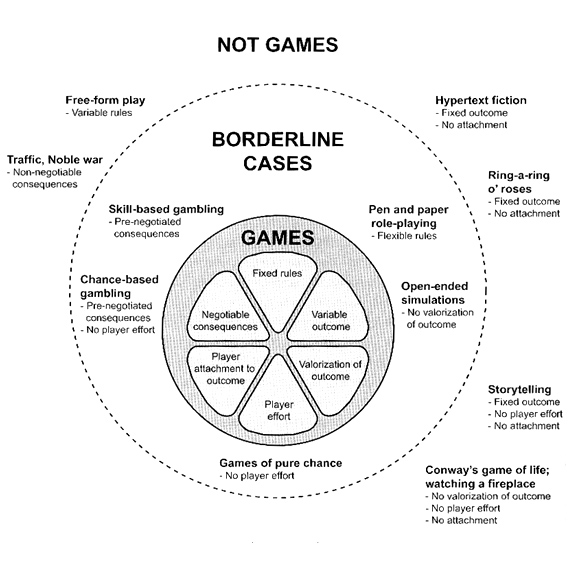
And I want to share an excellent diagram about the universe of the games from this book too:

And for last I want to leave a very interesting link from Jesper Juul´s site: its a "Dictionary of Video Game Theory". Click here to go to the URL.

Enjoy!


Reference:
JUUL, Jesper. Half-Real: Video Games between Real Rules and Fictional Worlds. USA: MIT Press, 2005.

Twitter

Competition