By Vince Vader
I really enjoyed writing my last post (
link here) about experience of players inside the games. So I've decided to write a little bit more about this fascinating subject. In this post I want to highlight some ideas to complete this thought.
I think there are three great aspects that help us understand the involvement of the players with the game universe: the idea of a
labyrinth, the concept of
virtual presence and the concept of
flow.
I like to use the idea of a labyrinth of games as a metaphor. I think it's important to offer the player a chance to get lost inside the game world. But it's very important to offer this as a challenge to be completed and not as a bad sensation that leads the player to nowhere. As Kerényi wrote, the concept of a labyrinth is possibly a cultural good of all humanity whose origins date back to the Stone Age (page 66) and possibly all the ludic activities results in a kind of maze (page 72). So we can conclude that the idea of a labyrinth is - in some way - a mythological heritage of us all.

Continuing the thought, it's important to study the concept of "presence" inside the game world. Offer the player a labyrinthine environment is easy but the great challenge is to put a virtual presence of the player into the game (using narrative resources, coherent game mechanics, good graphics, etc.).
Nitsche (page 203) in reference to Slater (1993) talks about forms of presence and argues that “presence” is understood as the mental state where a user subjectively feels present within a video game space as the result of an immersion into the content of the fictional world. It is a mental phenomenon based on a perceptual illusion. In reference to Lombard and Diltron (1997) Nitsche (page 203) says that a great number of researchers have concentrated on the idea that a state of presence should be connected to the illusion of a nonmediated experience. In this case, players do not see the interface anymore because they feel present in the world beyond the screen.
The last concept I want to discuss is “flow”. I’ll go back again to the author Michael Nitsche to complete this thought. Nitsche (page 204) citing Csikszentmihalyi (1991) says that “flow” has been introduced as a state in which a person is fully immersed in an action and highly focused to the extent that one can experience, for example,
a loss in the feeling of self-consciousness and time experience. A player who reaches this level is clearly immersed in the game but not necessarily “present” in the virtual space.
All these features help us to create good experiences involving games.
In a future post I want to discuss some ways to generate the idea of a labyrinth and the concepts of presence and flow. Szia!
References: CSIKSENTMIHALYI, Mihaly.
Flow: the psychology of optimal experience. New York: Perennial (HarperCollins), 1991.
KERÉNYI, Karl.
En El laberinto. Madrid: Ediciones Siruela, 2006.
LOMBARD, Matthew & DITTON Theresa.
At the heart of it all: the concept of telepresence. Journal of Computer-Mediated Communication 3, no. 2 (1997): 1-39.
NITSCHE, Michael.
VIDEO GAME SPACES - image, play and structure in 3Dnworlds. Massachusetts: MIT Press, 2008

 :.
:.


 Continuing the thought, it's important to study the concept of "presence" inside the game world. Offer the player a labyrinthine environment is easy but the great challenge is to put a virtual presence of the player into the game (using narrative resources, coherent game mechanics, good graphics, etc.).
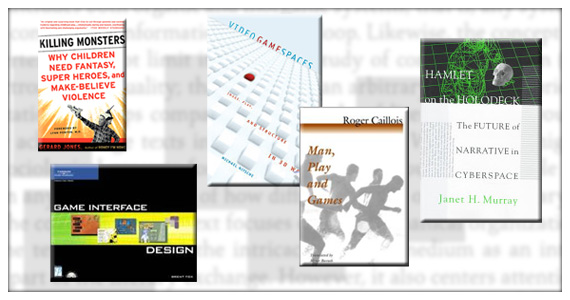 •Hamlet on the holodeck: the future of narrative in cyberspace by Janet Horowitz Murray (link)
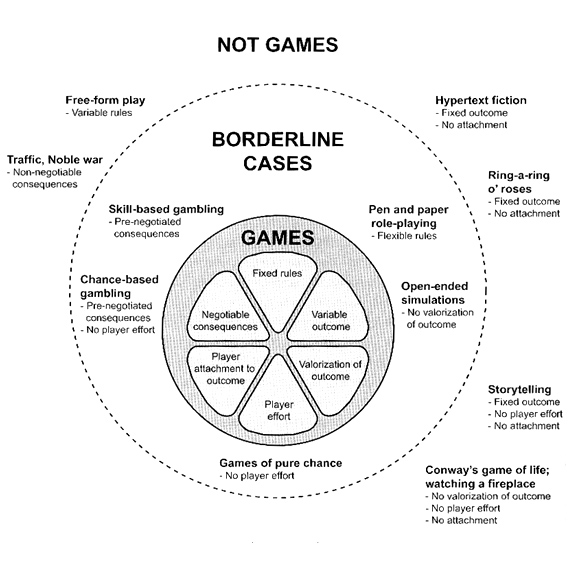 And for last I want to leave a very interesting link from Jesper Juul´s site: its a "Dictionary of Video Game Theory". Click here to go to the URL.