By
Laura Herrewijn (Guest author from University of Antwerp - Belgium)
Imagine two people, playing the same digital game. These players will not just engage in ready-made gameplay but will actively take part in the construction of their game experience by bringing their own desires, thoughts, feelings and meaning-making. Consequently, the digital game experience, including the emotional experience, of these two players will never be exactly the same. One player might experience a gaming episode as pleasant, while another is left with feelings of deep frustration. The question then is whether the different emotions and experiences a player encounters while playing a game have an effect on the way he or she processes elements of the game world, including in-game advertisements?In-game advertising (IGA) refers to the use of digital games as a medium for the delivery of advertisements. The last couple of years, IGA has developed into one of the fastest growing forms of advertising in terms of yearly spending and anticipated growth, mostly due to the increasing popularity of digital games and the large target audience that can be reached through this medium (Bardzell et al., 2008; Yankee Group, 2006). Yet, although in-game advertising is considered a “hot topic” among advertisers and media firms, academic research concerning the subject is still in its infancy (Bardzell et al., 2008). Therefore, the aim of this article is to contribute to the research on the effectiveness of IGA.

There is considerable evidence that advertising effectiveness in traditional media (e.g. print, radio and television) is influenced by several context characteristics, like the different emotions people encounter or the physical and social environment they are in while being exposed to an advertisement (Bronner et al., 2007; Moorman, 2003; Van Reijmersdal et al., 2010). Yet, research on the effects of context characteristics on advertising in digital games is still limited.
The present text therefore focuses on the relationship that exists between the effectiveness of in-game advertising and one specific context characteristic: player experiences during gameplay. Specifically, the goal is to get an insight in the way emotions and experiences while playing digital games influence player responses to in-game advertising. Digital games have the potential to evoke a wide array of general (e.g. pleasure, arousal) and more specific emotional experiences (e.g. frustration, competence) (Ermi & Mäyrä, 2005; Poels et al., 2009). Prior advertising research studying traditional media already showed that both the general (Pavelchak et al., 1988) and specific (Griskevicius et al., 2009) emotions people feel while watching an advertisement affect the way the audience responds to the advertisement. Consequently, emotional experiences might also exert an influence on the way people process elements in a digital game environment, including in-game advertisements. (...)
Click here to download the complete .PDF text. Thanks, Laura!
References:Bardzell, J., Bardzell, S. and Pace, T. (2008) “Player Engagement and In-Game Advertising”. Available at http://www.onetooneinteractive.com/wp-content/uploads/2009/07/otoinsights_in-game_ad_report.pdf (accessed November, 2009).
Bronner, F. E., Bronner, J. R. and Faasse, J. “In the Mood for Advertising”, in International Journal of Advertising vol. 26, no. 3 (2007), pp. 333-356.
Ermi, L. and Mäyrä, F. “Fundamental components of the gameplay experience: Analysing immersion”, in de Castell, S. and Jenson, J. (Eds.) “Changing Views: Worlds in Play” (2005), pp. 15-27. Selected papers of the 2005 Digital Games Research Association’s Second International Conference.
Griskevicius, V., Goldstein, N. J., Mortensen, C. R., Sundie, J. M., Cialdini, R. B. and Kenrick, D. T. “Fear and loving in Las Vegas: Evolution, emotion, and persuasion”, in Journal of Marketing Research vol. 46, no. 3 (2009), pp. 384-395.
Moorman, M. “Context considered. The relationship between media environments and advertising effects”, unpublished doctoral dissertation, Amsterdam: University of Amsterdam, 2003.
Pavelchak, M. A., Antil, J. H. and Munch, J. M. “The Super Bowl: an investigation into the relationship among program context, emotional experience, and ad recall”, in Journal of Consumer Research vol. 15, no. 3 (1988), pp. 360-367.
Poels, K., de Kort, Y. A. W. and IJsselsteijn, W. A. “Identification and Categorization of Digital Game Experiences. A Qualitative Study integrating Theoretical Insights and Player Perspectives”, working paper, Eindhoven University of Technology, 2009.
Van Reijmersdal, E., Smit, E. and Neijens, P. “How media factors affect audience responses to brand placement”, in International Journal of Advertising vol. 29, no. 2 (2010), pp. 279-302.

 :.
:.


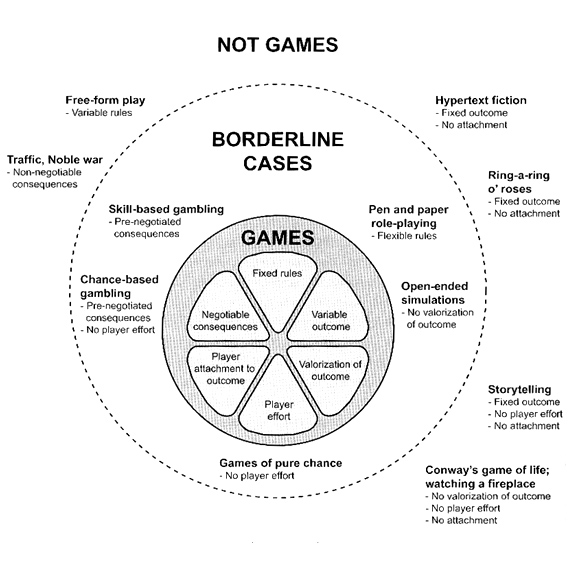 And for last I want to leave a very interesting link from Jesper Juul´s site: its a "Dictionary of Video Game Theory". Click here to go to the URL.
 In this volume, people of diverse backgrounds talk about tabletop games, game culture, and the intersection of games with learning, theater, and other forms. Some have chosen to write about their design process, others about games they admire, others about the culture of tabletop games and their fans. The results are various and individual, but all cast some light on what is a multivarious and fascinating set of game styles.