Games: Tools For Mass Communication

The source is Ogilvy notes: "Art, education, economics, propaganda. Games are arriving at the forefront of media to become an important way to engage entire generations of people. What's different from before? Five billion people are replacing the most common communication device, the simple cell phone, with a full-fledged gaming system in their pocket. There are multiple ways to publish and distribute games over the Internet and to the masses. For many, game creation is becoming a regular activity, as tools become both easier to use and more powerful for people without programming knowledge. This panel will cover unique perspectives on how games are becoming more meaningful forms of expression and a significant tool for communicating ideas".

Click to expand the image below:

Interview with Espen Aarseth

We have something new in this post: the first interview of the blog. An interview with Espen Aarseth (one of my favorite authors).

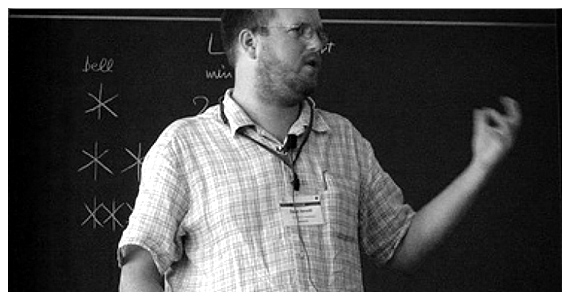
Espen J. Aarseth is a figure in the fields of video game studies and electronic literature. Aarseth was born in Bergen, Norway, in 1965 and completed his doctorate at the Department of Comparative Literature at the University of Bergen. He co-founded the Department of Humanistic Informatics at the University of Bergen, and worked there until 2003, at which time he was a full professor. He is currently Principal Researcher at the Center for Computer Games Research at the IT University of Copenhagen.

Let's rock!

Vince: There's a lot of definitions for "game". From Huizinga to contemporary authors we can find a lot of ideas about this subject. What's your definition of "game"?
Espen: I am with Wittgenstein on this one; '"game" ("Spiel") is a concept that cannot be formally defined, and when we try to do so, we inevitably end up with merely a definition of a sub genre. I do have a definition of games, but I also acknowledge that this is an overproductive definition, that also includes phenomena such as musical instruments: "Games are facilitators that structure behavior, mainly for the purpose of entertainment." Note that I don't use the word 'rules', but the broader term 'structure'.

Vince: What you think about the buzzword "Gamification"? Do you think it's a good concept to define the use of game elements in non-game activities?
Espen: It is an ideological attempt to make games important and useful; and a very naive view of how humans can be controlled. A scenario where gamification is successful could only be a nightmare. But in 7-8 years it will be forgotten. So do check my prediction in 2020.

Vince: In your book named "Cybertext" You said that "the concept of cybertext focuses on the mechanical organization of the text, by positing the intricacies of the medium as an integral part of the literary exchange". In what kind of game it's possible to see it clearly?
Espen: Mechanics is a crucial aspect in almost all games. Games are obvious, almost trivial examples of what I was talking about there. As I made clear in Cybertext, games are combinations of two layers, the semiotic and the mechanical, and this sets them apart from non-cybernetic media such as novels and films.

Vince: Send a message to the new researchers of the gaming concepts and game design field.
Espen: I believe we are entering a new phase in game research, where we already see glimpses of an academic field with professional standards of quality. We are not quite there yet, but hopefully the early days of sloppy research, terrible quality control and half-baked theorizing will soon be over. Things can only get better!

Vince: Thank you!
Espen: You are welcome!

Goals and rewards

By Vince

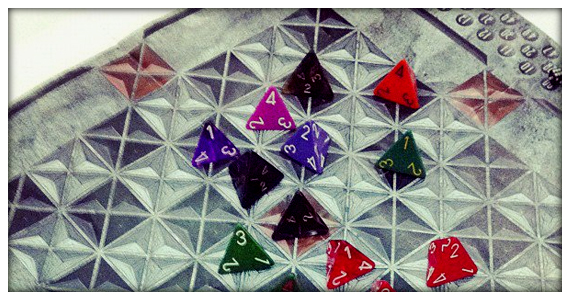
At this moment I'm working on my new board game named PYRAMYZ, a dice game that uses D4s as paws in an orthogonal board. I hope to cast this game by April or May of this year. I intend to write a complete review of the creative process of this new game after the launching, very similar to the review of my other board game named YN (link here).

While the production of the game is not finished I want to discuss an important point of the game design process: the creation of a logical goal/reward to the game mechanics. In the moment of conception of a new game, it is very common to think about components, complex mechanics, layout, and sometimes we forget to create a good and clear goal/reward to offer the players.

The goal of my new game is simple: to be the player with most victory points. And how can You get victory points? Putting the higher values of D4 dices in the squares of your color in the board. It's possible to have an idea in the image below:

In the book “Game Design: principles, practice, and tecniques - the ultimate guide for the aspiring game designer” there is a good view about this subject. The authors say:
“A crucial aspect of a game is that has a definite goal, and reaching this usually allows an individual to win. Goals can include eliminating the other player(s) from the game, achieving an identified target (for example by amassing a number of points), winning a race, or collecting a certain type of token.

Achieving the goal - winning - can be its own reward. A player may have defeated his opponent through his superior game-playing skill or he may simply have been lucky with random factors.

Many modern games, digital and non-digital, do not rely on winning as the sole reward but are designed so that all of the players can derive some enjoyment from the process of playing the game
”. (page 13)

Another good gaming concept! What do you think about that?


Reference:

THOMPSON, Jim; BERBANK-GREEN, Barnaby; CUSWORTH, Nic. Game Design: principles, practice, and tecniques - the ultimate guide for the aspiring game designer. New Jersey: Wiley, 2007

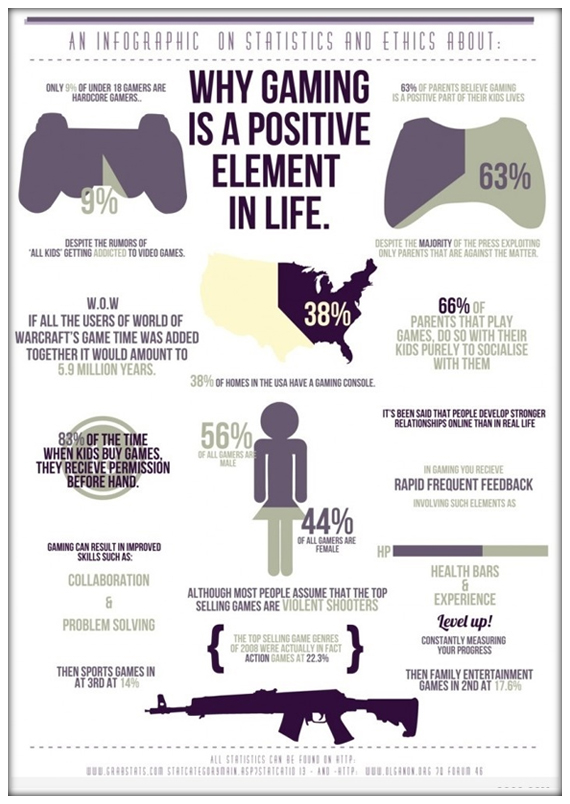
Good infographic

I like so much this infographic that shows the positive facts of gaming.

All information from http://www.grabstats.com/
Szia!

Kinds of players

What kind of player are you? It's a complicated question and in fact there are a lot of kinds of players. Just to give an example we can talk about the proposed types of players in a Massive Multiplayer Online Game. Schreiber (2009) citing Bartle (1996) says that in this genre of game it's possible to identify four types of players:

•Achievers >> find it enjoyable to gain power, level up, and generally to “win” the game (to the extent that an ongoing, never-ending game can be “won”).

•Explorers >> want to explore the world, build mental maps of the different areas in their heads, and generally figure out what is in their surroundings.

•Socializers >> use the game as a social medium. They play for the interaction with other players. The gameplay systems are just a convenient excuse to get together and play with friends.

•Killers >> (today we call them “griefers”) derive their fun from ruining other people’s fun.

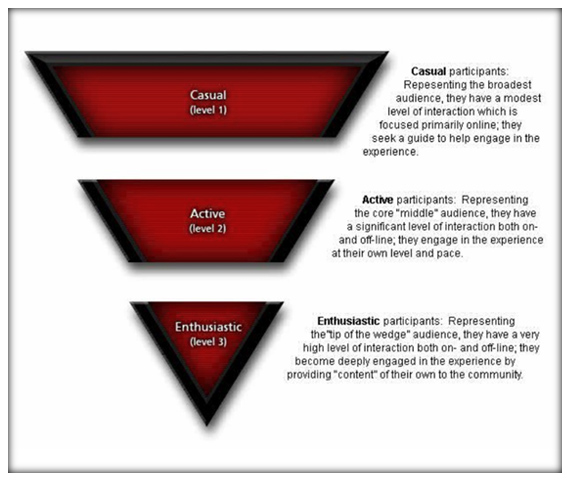
I think it's impossible to categorize all kinds of players of all gaming genres but I really like the synthetic idea of the graph below:

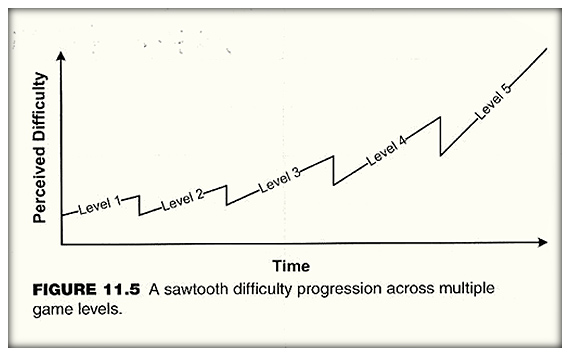
The most important point in the discussion about kinds of players is: know your audience to know how to create a consistent difficult progression and a good experience to the players. The next graph (from Fundamentals of Game Design, p.345) summarizes this thought:
I believe this is another fundamental concept to apply in game design.
What do you think about that?


References:

ADAMS, Ernest. Fundamentals of Game Design. New Riders: 2009

BARTLE, Richard. HEARTS, CLUBS, DIAMONDS, SPADES: PLAYERS WHO SUIT MUDS. Digital article (link here)

SCHREIBER, Ian. Kinds of Fun, Kinds of Players. Digital article (link here)

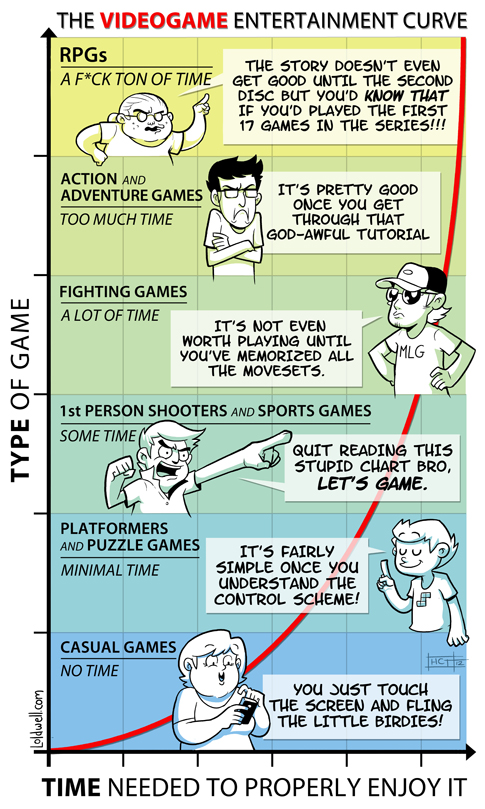
The videogame entertainment curve

The concept of cybertext

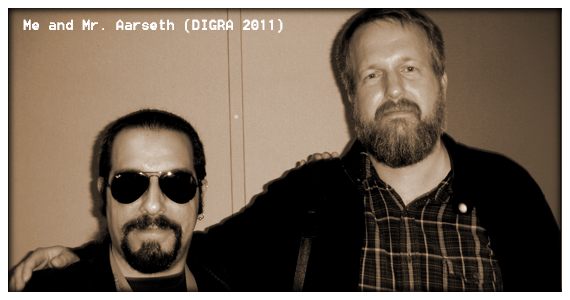
Last year (at DIGRA 2011/Netherlands) I had the honor to know personally one of my favorite authors: Espen Aarseth. Aarseth is a main figure in the fields of video game studies and electronic literature.

I really like some ideas from his book Cibertext and I want to share them in this post. I think that cybertext is an important concept inside the game design universe.

As Aarseth says:

The concept of cybertext focuses on the mechanical organization of the text, by positing the intricacies of the medium as an integral part of the literary exchange. However, it also centers attention on the consumer, or user, of the text, as a more integrated figure than even reader-response theorists would claim. The performance of their reader takes place all in his head, while the user of cybertext also performs in an extranoematic sense. During the cybertextual process, the user will have effectuated a semiotic sequence, and this selective movement is a work of physical construction that the various concepts of “reading” do not account for. This phenomenon I call ergodic, using a term appropriated from physics that derives from the Greek words ergon and hodos, meaning “work” and “path”. In ergodic literature, nontrivial effort is required to allow the reader to traverse the text. If ergodic literature is to make sense as a concept, there must also be nonergodic literature, where the effort to traverse the text is trivial, with no extranoematic responsibilities placed on the reader except (for example) eye movement and the periodic or arbitrary turning of pages. (page 1)

I believe this is a fundamental concept to apply in game writing.

What do you think about that?


Reference:

AARSETH, Espen. Cibertext: Perspectives on Ergodic Literature. The Johns Hopkins University Press: Maryland, 1997.

Twitter

Competition