
 :.
:.


Quote of the day
“The problems of puzzles are very near the problems of life, our whole life is solving puzzles. If you are hungry, you have to find something to eat. But everyday problems are very mixed - they're not clear. The Cube's problem depends just on you. You can solve it independently. But to find happiness in life, you're not independent. That's the only big difference.” - Ernő Rubik (Hungarian, Architect and creator of the Magic Cube)
Monday, December 19, 2011
// 0 comments
Simple and elegant: the essence of game design
Two days ago I've visited (again) a video game exhibition in my city (São Paulo) named GAME ON. There's a lot of good stuff in the place from all periods of the history of video games.
From ATARI till Xbox 360 with Kinect the exhibition gives to us a complete panorama of evolution, technology, design, language, mechanics and market in the video games universe.
The visit inspired myself to write this post. I've played a lot of classics of my childhood in the fair: Pitfall (ATARI, Activison, 1985), Space Invaders (Arcade, Taito, 1978), Donkey Kong (Arcade, Nintendo, 1981), Pac Man (Arcade, Namco, 1980) and many others in different platforms.
But I want to talk about a particular one. I want to talk about PONG, one of the first well succeed games in the history and a game with a great importance in the contemporary scene of communication. PONG is part of a series of experiments in which people began to interact with screens and became more than mere spectators.
 PONG it´s an example of simple and elegant game design. It´s simple because there´s only one rule printed in the arcade: "avoid missing ball for high score" and it´s elegant by the minimalist design/idea of a table tennis made with few elements in the screen.
Salen and Zimmerman in the preface of the book Rules of Play (page XIII and XIV) explain why PONG is a successful game. The authors explain that the game despite its almost primitive simplicity, creates meaningful play. PONG is simple to play, every game is unique, it´s social (requires two players to play) and finally it´s fun and cool.
PONG still alive today. We can see the idea and mechanics of this game in new versions, new layout, internet ads and a lot of other places. PONG is a proof that good game design can survive the time.
And you? What do you think about that?
Game over! =)
Reference:
SALEN, Katie & ZIMMERMAN, Eric. Rules of Play: game design fundamentals. Massachusetts; The MIT Press, 2004
From ATARI till Xbox 360 with Kinect the exhibition gives to us a complete panorama of evolution, technology, design, language, mechanics and market in the video games universe.
The visit inspired myself to write this post. I've played a lot of classics of my childhood in the fair: Pitfall (ATARI, Activison, 1985), Space Invaders (Arcade, Taito, 1978), Donkey Kong (Arcade, Nintendo, 1981), Pac Man (Arcade, Namco, 1980) and many others in different platforms.
But I want to talk about a particular one. I want to talk about PONG, one of the first well succeed games in the history and a game with a great importance in the contemporary scene of communication. PONG is part of a series of experiments in which people began to interact with screens and became more than mere spectators.
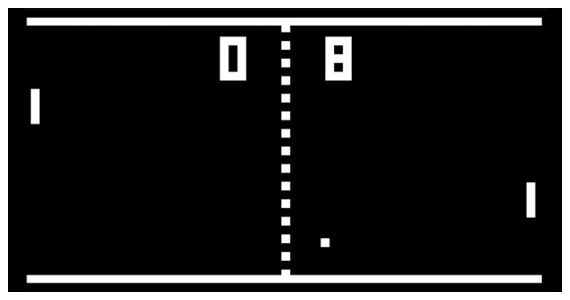 PONG it´s an example of simple and elegant game design. It´s simple because there´s only one rule printed in the arcade: "avoid missing ball for high score" and it´s elegant by the minimalist design/idea of a table tennis made with few elements in the screen.
Salen and Zimmerman in the preface of the book Rules of Play (page XIII and XIV) explain why PONG is a successful game. The authors explain that the game despite its almost primitive simplicity, creates meaningful play. PONG is simple to play, every game is unique, it´s social (requires two players to play) and finally it´s fun and cool.
PONG still alive today. We can see the idea and mechanics of this game in new versions, new layout, internet ads and a lot of other places. PONG is a proof that good game design can survive the time.
And you? What do you think about that?
Game over! =)
Reference:
SALEN, Katie & ZIMMERMAN, Eric. Rules of Play: game design fundamentals. Massachusetts; The MIT Press, 2004
Tuesday, December 13, 2011
// 0 comments
Games and movies. Movies and games.
A few posts ago (click here to read) I've published an interesting point of view about the key difference between games and movies in the words of the game designer Sid Meier.
In this post I want to highlight this idea with some quotations from the book Video Gane Spaces. In the words of Nitsche (page 57) the filmmaker says, 'Look, I'll show you.' The spacemaker says, 'Here, I'll help you discover'. And Jenkins suggests that we should "think of game designers less as storytellers than as narrative architects" (page 129) who "don´t simply tell stories; they design worlds and sculpt spaces" (ibid., 121).
In this post I want to highlight this idea with some quotations from the book Video Gane Spaces. In the words of Nitsche (page 57) the filmmaker says, 'Look, I'll show you.' The spacemaker says, 'Here, I'll help you discover'. And Jenkins suggests that we should "think of game designers less as storytellers than as narrative architects" (page 129) who "don´t simply tell stories; they design worlds and sculpt spaces" (ibid., 121).
I really like the idea of denominate the game designer a kind of spacemaker. In fact we are talking about spaces with interactions, rules and players.
Despite the differences is undeniable that the films strongly influence the games. And it is undeniable that games also greatly influence the films.
 In a future post I want to discuss this aspect. I want to talk about the dynamics of how movies become games (eg Iron Man) and how games become movies (eg Silent Hill).
 In a future post I want to discuss this aspect. I want to talk about the dynamics of how movies become games (eg Iron Man) and how games become movies (eg Silent Hill).
See you!
References:
NITSCHE, Michael. VIDEO GAME SPACES - image, play and structure in 3D worlds. Massachusetts: MIT Press, 2008.
JENKINS, Henry."Game Design as Narrative Architecture" In First Person: New Media as Story, Performance and Game, edited by Pat Harrington and Noah Wardrup-Fruin, 118-131. Cambridge, MA, and London: MIT Press, 2004.
References:
NITSCHE, Michael. VIDEO GAME SPACES - image, play and structure in 3D worlds. Massachusetts: MIT Press, 2008.
JENKINS, Henry."Game Design as Narrative Architecture" In First Person: New Media as Story, Performance and Game, edited by Pat Harrington and Noah Wardrup-Fruin, 118-131. Cambridge, MA, and London: MIT Press, 2004.
Wednesday, December 7, 2011
// 0 comments
A good quote for today
"Playing a game is a voluntary attempt to overcome unnecessary obstacles" - Bernard Suits (in The Grasshopper: Games, Life and Utopia)
Saturday, December 3, 2011
// 0 comments
Five planes
I'm reading an interesting book: VIDEO GAME SPACES - image, play and structure in 3D worlds. I've found a very good approach about the interface between the game and the player(s).
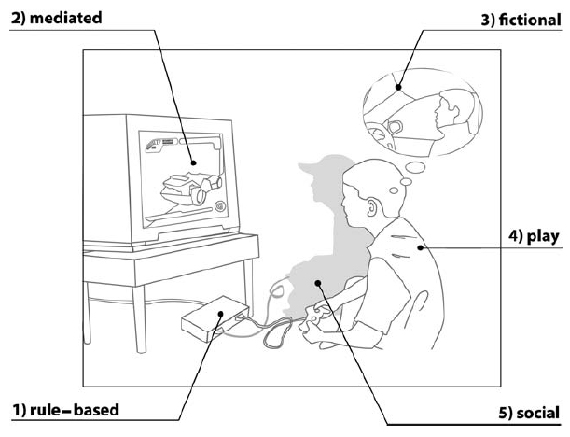
The author theorizes about a "five planes" idea. These planes are:
1. rule-based as defined by the mathematical rules that set, for example, physics, sounds, artificial intelligence, and game-level architecture. Players do not have to understand the logic of the code but of the mediated game world. "Beyond the fantasy, there are always the rules" (TURKLE, 1984, p.83);
2. mediated space as defined by the presentation, which is the space of the image plane and the use of this image including the cinematic form of presentation;
3. fictional space that lives in the imagination, in other words, the space "imagined" by players from their comprehension of the available images;
4. play space, meaning space of the play, which includes the player and the video game hardware; and
5. social space defined by interaction with others, meaning the game space of other players affected (e.g., in a multiplayer title).
The author synthetizes this idea in the image below:

The book is about video games but I think it's a good model to analyze any kind of game. And you? What do you think about that?
References:
NITSCHE, Michael. VIDEO GAME SPACES - image, play and structure in 3D worlds. Massachusetts: MIT Press, 2008.
TURKLE, Sherry. The Second Self: Computers and the Human Spirit. New York: Simon & Schuster, 1984
The author theorizes about a "five planes" idea. These planes are:
1. rule-based as defined by the mathematical rules that set, for example, physics, sounds, artificial intelligence, and game-level architecture. Players do not have to understand the logic of the code but of the mediated game world. "Beyond the fantasy, there are always the rules" (TURKLE, 1984, p.83);
2. mediated space as defined by the presentation, which is the space of the image plane and the use of this image including the cinematic form of presentation;
3. fictional space that lives in the imagination, in other words, the space "imagined" by players from their comprehension of the available images;
4. play space, meaning space of the play, which includes the player and the video game hardware; and
5. social space defined by interaction with others, meaning the game space of other players affected (e.g., in a multiplayer title).
The author synthetizes this idea in the image below:
The book is about video games but I think it's a good model to analyze any kind of game. And you? What do you think about that?
References:
NITSCHE, Michael. VIDEO GAME SPACES - image, play and structure in 3D worlds. Massachusetts: MIT Press, 2008.
TURKLE, Sherry. The Second Self: Computers and the Human Spirit. New York: Simon & Schuster, 1984
Tuesday, November 29, 2011
// 0 comments
Ludologists love stories, too: notes from a debate that never took place
By Gonzalo Frasca (Thanks for share the text in my blog!)
ABSTRACT
During the last few years, a debate took place within the game scholars community. A debate that, it seems, opposed two groups: ludologists and narratologists. Ludologists are supposed to focus on game mechanics and reject any room in the field for analyzing games as narrative, while narratologists argue that games are closely connected to stories. This article aims at showing that this description of the participants is erroneous. What is more, this debate as presented never really took place because it was cluttered with a series of misunderstandings and misconceptions that need to be clarified if we want to seriously discuss the role of narrative in videogames.
Keywords
Ludology, narratology, ludologist, narratologist, narrativism, narrativist.
INTRODUCTION
This is an unusual article. My original intention was writing a paper on the role of narrative in videogames (through cutscenes and instructions) for conveying simulation rules. When I mentioned this to a colleague, he was shocked: he thought that, since I amknown as a ludologist, there was no way I could accept any role for narrative in games. Of course, I told him he was wrong and that such idea of ludology is totally erroneous. That misconception is, I think, a direct consequence of the so-called narratology versus ludology debate. I believe that this debate has been fueled by misunderstandings and that generated a series of inaccurate beliefs on the role of ludology, including that they radically reject any use of narrative theory in game studies.
 Since I guess that I have been in a privileged position to witness the development of this debate over the last four years, I decided to write down a list of the most common misconceptions that it generated. It is not my main intention in this paper to support ludology but rather making explicit all the contradictions that prevented this debate from taking place. However, I do not pretend to be totally objective neither: I do not favor narrative as a privileged means for understanding videogames for reasons that have been previously exposed by several authors and are beyond the scope of this article. Finally, I would like to make clear that I will be speaking only for myself and I am the only responsible for all the opinions expressed in this article.
CLICK HERE to download the complete document.
ABSTRACT
During the last few years, a debate took place within the game scholars community. A debate that, it seems, opposed two groups: ludologists and narratologists. Ludologists are supposed to focus on game mechanics and reject any room in the field for analyzing games as narrative, while narratologists argue that games are closely connected to stories. This article aims at showing that this description of the participants is erroneous. What is more, this debate as presented never really took place because it was cluttered with a series of misunderstandings and misconceptions that need to be clarified if we want to seriously discuss the role of narrative in videogames.
Keywords
Ludology, narratology, ludologist, narratologist, narrativism, narrativist.
INTRODUCTION
This is an unusual article. My original intention was writing a paper on the role of narrative in videogames (through cutscenes and instructions) for conveying simulation rules. When I mentioned this to a colleague, he was shocked: he thought that, since I amknown as a ludologist, there was no way I could accept any role for narrative in games. Of course, I told him he was wrong and that such idea of ludology is totally erroneous. That misconception is, I think, a direct consequence of the so-called narratology versus ludology debate. I believe that this debate has been fueled by misunderstandings and that generated a series of inaccurate beliefs on the role of ludology, including that they radically reject any use of narrative theory in game studies.
 Since I guess that I have been in a privileged position to witness the development of this debate over the last four years, I decided to write down a list of the most common misconceptions that it generated. It is not my main intention in this paper to support ludology but rather making explicit all the contradictions that prevented this debate from taking place. However, I do not pretend to be totally objective neither: I do not favor narrative as a privileged means for understanding videogames for reasons that have been previously exposed by several authors and are beyond the scope of this article. Finally, I would like to make clear that I will be speaking only for myself and I am the only responsible for all the opinions expressed in this article.
CLICK HERE to download the complete document.
Monday, November 28, 2011
// 0 comments
Subscribe to:
Posts (Atom)