Essential books about game design & gaming concepts - EPISODE III

Another six good books from my particular game design library to complement the first and the second posts of this subject. In the end of each topic of this post there´s a link to Google Books with previews.

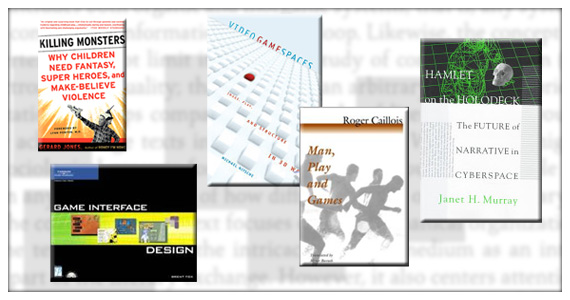
•Hamlet on the holodeck: the future of narrative in cyberspace by Janet Horowitz Murray (link)

•Game interface design by Brent Fox (link)

•Killing monsters: why children need fantasy, super heroes, and make-believe violence by Gerard Jones (link)

•Man, play, and games by Roger Caillois (link)

•Imagination and Play in the Electronic Age by Dorothy G. Singer, Jerome L. Singer (link)

•Video game spaces: image, play, and structure in 3D game worlds by Michael Nitsche (link)

The game inside the game

By Vince

I’m playing Batman – Arkham City. Without a doubt – in my humble opinion – it’s the game of the year (despite some bad points of the script). I still prefer the first one (Batman – Arkham Asylum) but I’m really happy with the experience of Arkham City.

I think the game offers a good experience because of a lot of good features: excellent combat mechanics (with very funny combo sequences); beautiful ambient (the streets and buildings of Gotham are awesome); good selection of villains (ok, it’s easy with Batman); clever extra challenges; the mini games inside the main game - and I want to talk a little more about this last feature.


In Arkham City, like in Arkham Asylum, you have one main mission to accomplish and a lot of parallel missions hidden in the scenario. Some examples of this side missions are: solve puzzles from Riddler scattered around the map; find Azrael’s mystical signs; save political prisoners; save victims from the villain Deadshot; destroy gallons filled with poison; get skilled in the virtual reality flying training, etc.

This kind of extra content offers the player more hours of fun, more challenges to finish and more trophies/achievements to his or her social network. And offers the experience of the metagaming.

As we can find in Wikipedia metagaming is a broad term usually used to define any strategy, action or method used in a game which transcends a prescribed ruleset, uses external factors to affect the game, or goes beyond the supposed limits or environment set by the game.

And going beyond the extra games, Arkham City presents a very funny web tool: a searching engine (like Google) managed by Alfred Pennyworth (Batman´s right arm) in this address: http://alfredatyourservice.co.uk/ .In the first Batman game it’s possible to access a “real” website of the Arkham Asylum in this address http://arkhamcare.com/ to expand the experience of the game outside the television screen.

I think this kind of practice is necessary nowadays to attend a very wide public. In “Collective Intelligence”, Pierre Levy offers a compelling vision of the new “knowledge space”, or what he calls “the cosmopedia” that might emerge as citizens more fully realize the potencials of the new media environment. The members of a thinking community search, inscribe, connect, consult, explore... Not only does the cosmopedia make available to the collective intellect all of the pertinent knowledge available to it at a given moment, but it also serves as a site of collective discussion, negociation, and development.

And you? What do you think about that?


References:

LEVY, Pierre. Collective Inteligence: Mankind´s Emerging World in Cyberspace. UK: Cambridge-Perseus, 1997. p.217.

Interview with game designer Reiner Knizia (DIGRA 2011)

Games need to reflect our high-paced way of life. That’s what Reiner Knizia thinks. And if there’s someone who knows about these things, it’s Knizia. He designed over 200 games. Mostly board games, for which he received numerous awards. Submarine Channel talked to the enthusiastic game designer about the new dynamics of today’s games.

Board game designer Reiner Knizia interview from SubmarineChannel on Vimeo.


This interview was recorded at the THINK DESIGN PLAY // 5th DiGRA Conference on games and play, 2011.

Sid Meier speaks

"There's a key difference between games and movies. In a game, the more attention that's focused on the player, the more successful it is. In a movie, you're really watching somebody else's story, so the better the story or the better the actor, the more interested you are in the movie. In a game, the more interesting you are as a player, the more successful the game is. So, in a way, things that work in movies are designed to impress you with what somebody else is doing. A good game impresses you with what you're doing. I think that's a fundamental difference that I as a game designer need to recede in the background. The more the player is thinking about the design or the designer, the less successful I've been, because I want the player to forget somebody designed this game, forget that this is a game, and believe that this is an experience that the player is having. Whereas in a movie, the more you're aware of the director or the stars, the more you're impressed with them - that helps the movie to be successful. In a way, trying to impress people with design or personality or whatever works to promote movies doesn't work with games because it takes the focus off the player who is supposed to be the star. The more the player is the star, the better a game you have."

Sid Meier*


*Sidney K. "Sid" Meier (born February 24, 1954) is a Canadian programmer and designer of several popular computer strategy games, most notably Civilization. He has won accolades for his contributions to the computer games industry.

Essential books about game design & gaming concepts - EPISODE II

Another five good books to complement the previous post. In the end of each topic of this post there´s a link to Google Books with previews. Enjoy and send me new suggestions.


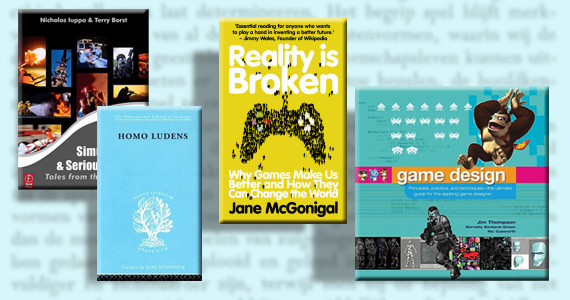
•Game design course: principles, practice, and techniques by Jim Thompson, Barnaby Berbank-Green & Nic Cusworth. (link)

•Reality is Broken: Why Games Make Us Better and How They Can Change the World by Jane McGonigal. (link)

•Cybertext: perspectives on ergodic literature by Espen J. Aarseth. (link)

•Story and simulations for serious games: tales from the trenches by Nicholas V. Iuppa & Terry Borst. (link)

•Homo Ludens: A Study of the Play-Element in Culture by Johan Huizinga. (link)

Essential books about game design & gaming concepts - EPISODE I

I want to share some of my favorites books about games in this post, so I've created a first list with ten good titles. There are good references to academic research and how to create games. In the end of each topic of this post there´s a link to Google Books with previews. Enjoy and send me new suggestions.


•Fundamentals of game design by Ernest Adams. (link)

•Challenges for game designers by Brenda Brathwaite, Ian Schreiber. (link)

•A theory of fun for game design by Raph Koster. (link)

•Game design workshop: a playcentric approach to creating innovative games by Tracy Fullerton, Christopher Swain & Steven Hoffman. (link)

•Casual Game Design: Designing Play for the Gamer in ALL of Us by Gregory Trefry. (link)

•Half-real: video games between real rules and fictional worlds by Jesper Juul. (link)

•Game writing: narrative skills for videogames by Chris Mark Bateman. (link)

•Extra Lives: Why Video Games Matter by Tom Bissell. (link)

•The Ultimate Guide to Video Game Writing and Design by Flint Dille & John Zuur Platten. (link)

Think about it

"Games are a mirror of our lives and times." - Reiner Knizia (at DIGRA 2011)

Twitter

Competition