CLICK HERE FOR DOWNLOAD.
Free book for download
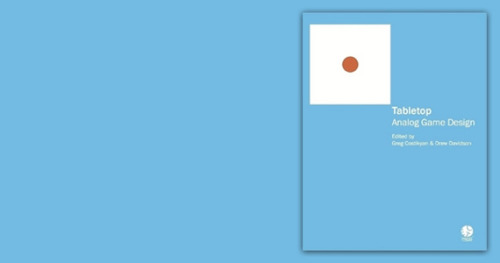
I´m talking about this excellent book named "Tabletop: Analog Game Design" by Drew Davidson and Greg Costikyan. There are a lot of good texts with great explanations and researches of the universe of analog games.
In this volume, people of diverse backgrounds talk about tabletop games, game culture, and the intersection of games with learning, theater, and other forms. Some have chosen to write about their design process, others about games they admire, others about the culture of tabletop games and their fans. The results are various and individual, but all cast some light on what is a multivarious and fascinating set of game styles.
CLICK HERE FOR DOWNLOAD.
Labels:
book,
download,
free,
game,
gamedesign
Game design process: a second approach
By Vince
In a previous post I’ve talked about the process to create a board game. In this post I intent to discuss a different kind of game design process, I want to discuss the creation of a mobile phone game made in SMS (short message service).
The game discussed in this case is a promotional game made to a Brazilian mobile company named VIVO and the name of the game is “VIVO EM AÇÃO” (something like “live in action” in English). This promotional action was a detective game with a history focused on clues and enigmas; the player takes an investigator role and needs to solve a lot of mysteries to have more chances to gain the promotional prizes (PlayStations, mobile phones, backpacks, etc.).
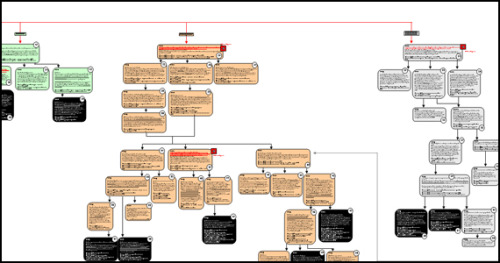
The game is based in mobile text messages. So we needed to create a script with information architecture basis; the script of the game is made of what we can call “decision trees”.
This is very simple to understand: it’s very similar to an old role playing game book. You read a paragraph and the text shows you a bunch of options to go ahead in the narrative.
For instance:
“Detective, you are in front of the university. What are you going to do? Option 1: enter the building; Option 2: search for clues around; 3) Option 3: try to enter the back door”
So each chapter of the game (and we made five chapters) looks like this:
As a promotional game, it is important to create points in the narrative where we can offer pay services from the mobile company. So, we decided to put – as a help to the players – hints and tips of the game that the player can buy using services and other tools of the company.
The great challenge here is to create a game based only in limited text (because each message needed to have a maximum of 138 characters) and build an immersive and fun narrative to get the player inside the story.
In a previous post I’ve talked about the process to create a board game. In this post I intent to discuss a different kind of game design process, I want to discuss the creation of a mobile phone game made in SMS (short message service).
The game discussed in this case is a promotional game made to a Brazilian mobile company named VIVO and the name of the game is “VIVO EM AÇÃO” (something like “live in action” in English). This promotional action was a detective game with a history focused on clues and enigmas; the player takes an investigator role and needs to solve a lot of mysteries to have more chances to gain the promotional prizes (PlayStations, mobile phones, backpacks, etc.).
The game is based in mobile text messages. So we needed to create a script with information architecture basis; the script of the game is made of what we can call “decision trees”.
This is very simple to understand: it’s very similar to an old role playing game book. You read a paragraph and the text shows you a bunch of options to go ahead in the narrative.
For instance:
“Detective, you are in front of the university. What are you going to do? Option 1: enter the building; Option 2: search for clues around; 3) Option 3: try to enter the back door”
So each chapter of the game (and we made five chapters) looks like this:
The great challenge here is to create a game based only in limited text (because each message needed to have a maximum of 138 characters) and build an immersive and fun narrative to get the player inside the story.
This promotion had a great audience. Around 2 million of people participating in it, making it a successful Brazilian case.
It was a great challenge to create this game because of his limitations. But I think that limitations are an important piece of the game design process.
And you? What do think about that?
It was a great challenge to create this game because of his limitations. But I think that limitations are an important piece of the game design process.
And you? What do think about that?
Labels:
gamedesign,
gamingconcepts,
mobile,
promotion,
vincevader
Quote of the day
“I think of games as being an amplifier for the imagination, in the same way that a car amplifies our legs or a house amplifies our skin (…)”
Will Wright
DIGRA 2011. Keynote: Eric Zimmerman
The award-winning veteran game designer talking about game development in DIGRA Think Design Play Conference. It´s a very short movie with the core of the presentation.
Enjoy.
Enjoy.
Labels:
DIGRA,
education,
game,
gamedesign,
gamingconcepts
All games share four defining traits
No matter the platform, the games share some essential features. May be "Tic Tac Toe" or "Gears of War 3" you can find some similarities between them. Let's see four main points:
•The goal: is the specific outcome that players will work to achieve
•The rules: place limitations on how players can achieve the goal.
•The feedback system: tells players how close they are to achieving the goal.
•The voluntary participation: requires that everyone who is playing the game knowingly and willingly accepts the goal, the rules, and the feedback.
Source: McGONIGAL, Jane. The reality is broken. London: The Penguin Press, 2011, pg. 21
•The rules: place limitations on how players can achieve the goal.
•The feedback system: tells players how close they are to achieving the goal.
•The voluntary participation: requires that everyone who is playing the game knowingly and willingly accepts the goal, the rules, and the feedback.
Source: McGONIGAL, Jane. The reality is broken. London: The Penguin Press, 2011, pg. 21
Labels:
game,
gamedesign,
gamingconcepts
# Why study games?
In this post I intend to show seven points of view to answer this question. There are some interesting links to download .PDF documents in the end of topics. Enjoy!
1.First of all, in the last eight years the game industry has grown more than any other in entertainment and games have overdone cinema revenues and are now the third industry in the world, being beat only by weapons and automobilistic industries.
2.Globally, the online gamer community – including console, PC, and mobile phone gamimg – counts more than 4 million gamers in the Middle East, 10 million in Rússia, 105 million in Índia, 10 million in Vietnam, 10 million in México, 13 million in Central and South América, 15 million in Austrália, 17 million in Soth Korea, 100 million in Europe, and 200 million in China.
Source: Games Segmentation 2008 Market Research Report (download link)
3.With all of this play, we have turned digital games (PC, consoles, mobile phones, etc.) into what is expected to be a $68 billion industry annually by the year 2012.
Source: NewZoo Amsterdam 2010 (download link)
4.In the USA:
• 97% of youth play computer and video games;
• 69% of all heads of household play computer and video games;
• 40% of all gamers are women;
• One out of four gamers is over the age of fifty;
• The average game player is thirty-five years old and has been playing for 12 years;
• Most gamers expect to continue playing games for the rest of their lives.
Source: ESA Essential Facts 2010 (download link)
5.Collectivelly, the planet is now spending more than 3 billion hours a week gaming.
Source: McGONIGAL, Jane. The reality is broken. London: The Penguin Press, 2011, pg. 5
6.In 2010 the first person shooter game"Call of Duty: Black Ops” has sold over U$ 1 billion in the first month.
7.The truth is this: in today´s society, computer and video games are fulfilling genuine human needs that the real world is currently unable to satisfy. Games are providing rewards that reality is not. They are teaching and inspiring and enganging us in ways that reality is not. They are bringing us together in ways that reality is not.
1.First of all, in the last eight years the game industry has grown more than any other in entertainment and games have overdone cinema revenues and are now the third industry in the world, being beat only by weapons and automobilistic industries.
2.Globally, the online gamer community – including console, PC, and mobile phone gamimg – counts more than 4 million gamers in the Middle East, 10 million in Rússia, 105 million in Índia, 10 million in Vietnam, 10 million in México, 13 million in Central and South América, 15 million in Austrália, 17 million in Soth Korea, 100 million in Europe, and 200 million in China.
Source: Games Segmentation 2008 Market Research Report (download link)
3.With all of this play, we have turned digital games (PC, consoles, mobile phones, etc.) into what is expected to be a $68 billion industry annually by the year 2012.
Source: NewZoo Amsterdam 2010 (download link)
• 97% of youth play computer and video games;
• 69% of all heads of household play computer and video games;
• 40% of all gamers are women;
• One out of four gamers is over the age of fifty;
• The average game player is thirty-five years old and has been playing for 12 years;
• Most gamers expect to continue playing games for the rest of their lives.
Source: ESA Essential Facts 2010 (download link)
5.Collectivelly, the planet is now spending more than 3 billion hours a week gaming.
Source: McGONIGAL, Jane. The reality is broken. London: The Penguin Press, 2011, pg. 5
6.In 2010 the first person shooter game"Call of Duty: Black Ops” has sold over U$ 1 billion in the first month.
7.The truth is this: in today´s society, computer and video games are fulfilling genuine human needs that the real world is currently unable to satisfy. Games are providing rewards that reality is not. They are teaching and inspiring and enganging us in ways that reality is not. They are bringing us together in ways that reality is not.
Source: McGONIGAL, Jane. The reality is broken. London: The Penguin Press, 2011, pg. 4
Labels:
game,
gamedesign,
industry,
market,
trends
Game design process: an approach
By Vince
The game I'll use as an example in this post is YN (this is greek for "earth"). However, the game suffered a lot of changes from its creation until it was published. I want to show the different phases of this game design process.
Also, I would like to emphasize that this is just one way we can use to create games. I believe each game designer has his/her own techniques to create game ideas and gaming concepts.
•STAGE 1: write ideas, rough draft and pre-prototype them
First of all, I believe it is important to have a notebook to write your ideas. In this moment, use the force and let your mind flow, start to write every important thing. I use to call this process “single player brainstorm”.
While writing the ideas try to draw some rough drafts of the core idea of the game. It’s the first tests of mechanics and dynamics.
In the case of YN, I was thinking of an area control game with dices and dominos sequence mechanics. I’ve made a lot of studies and drawings to reach the balance of core mechanics, board layout, number of dices to each player and the most important: seeing if the game works
I think it's important – in this moment - to consider the idea that game design is the process of creating the content and rules of a game, and good game design is the process of creating goals that a player feels motivated to reach and rules that a player must follow as he makes meaningful decisions in pursuit of those goals. (BRATHWAITE & SCHREIBER, 2009)
So, in a few days I had a lot of rules notations and a pre-prototype board to start a beta test with some friends. In the picture below it’s possible to see the first model of the game (without an official name at this moment) made with paper, pen and a bunch of white dices.
•STAGE 2: prototype with simple layout
Well, if the pre-prototype works I think it’s fine to make a better version of the product. It’s time to make a real prototype in the computer using a minimum of layout just to give the game a clear aspect.
I always use Photoshop to create my prototypes. There’s a lot of tools in the software and it’s possible to make fast layouts in its interface.
In this part of the process I had an idea for the name of the game. I called it “Hatszög” (it means hexagon in Hungarian, I know it´s weird, but I am a hungarian language student) and I made a better board, bought good dices and even made a box with a simple illustration. And an important thing: in this moment the game had its rule book ready.
In the next picture it’s possible to see the prototype with a simple layout.
•STAGE 3: final and published version
So, we reach the third and final part of our game design process. A Brazilian company named HIDRA GAMES asked for an idea for a collection of abstracts games. This company already had a first game named AERO (with the idea of AIR element as the main theme) and was searching for a mechanics for the second game of the series: YN (with the EARTH theme).
So “Hatszög” turned into YN and a lot of things changed. In the mechanics we added a new element: a stone token that creates different setups on the board; so now it’s possible to put a sequence of dices from your pool and sometimes block the opponent’s strategy (and we made a lot of new beta testing sessions to adjust this new feature in the game). Just to remember and explain, the goal of the game is to place the biggest amount of dices as possible in the board, with the purpose to finish the game with the smaller sum of numbers on the remaining dices.
Well, the name has changed and the game gained a brilliant art from Marcelo Bissoli (a specialist in boardgame layout). He made a lot of changes like removing hexagons and putting circles in place. Marcelo also made a very beautiful volcanic background to the board and a spectacular box with a very vibrant and strong logo. Now we a have a finished game in all phases.
And the text behind YN’s box tells us: “Billions of years ago, when the earth was just an incandescent globe that began to cool - big masses of rocks and ores, that were before in a liquid state, started to solidify, creating what we call today a terrestrial crust. The magma, still boiling and liquid, started big waves around an unstable soil and this huge rock layers collided and rose from the soil, creating the mountains. In YN a player will experience the idea of creating these mountain rages using dices in a scenario that simulates the Earth at its formation process”.
Let´s see a little bit of the final layout of the game:
In a few words I think I transmitted the core idea of a game design process. I intend to show, in another post, the game design process to a narrative game, more specifically a mobile phone game where the player uses only SMS (short message service) to play. There are a lot of differences to show.
•REFERENCE:
BRATHWAITE, Brenda & SCHREIBER, Ian. CHALLENGES FOR GAME DESIGNERS: non-digital exercises for vídeo game designers. USA: Cengage, 2009.
Labels:
game,
gamedesign,
gamingconcepts,
vincevader,
yn
Subscribe to:
Posts (Atom)